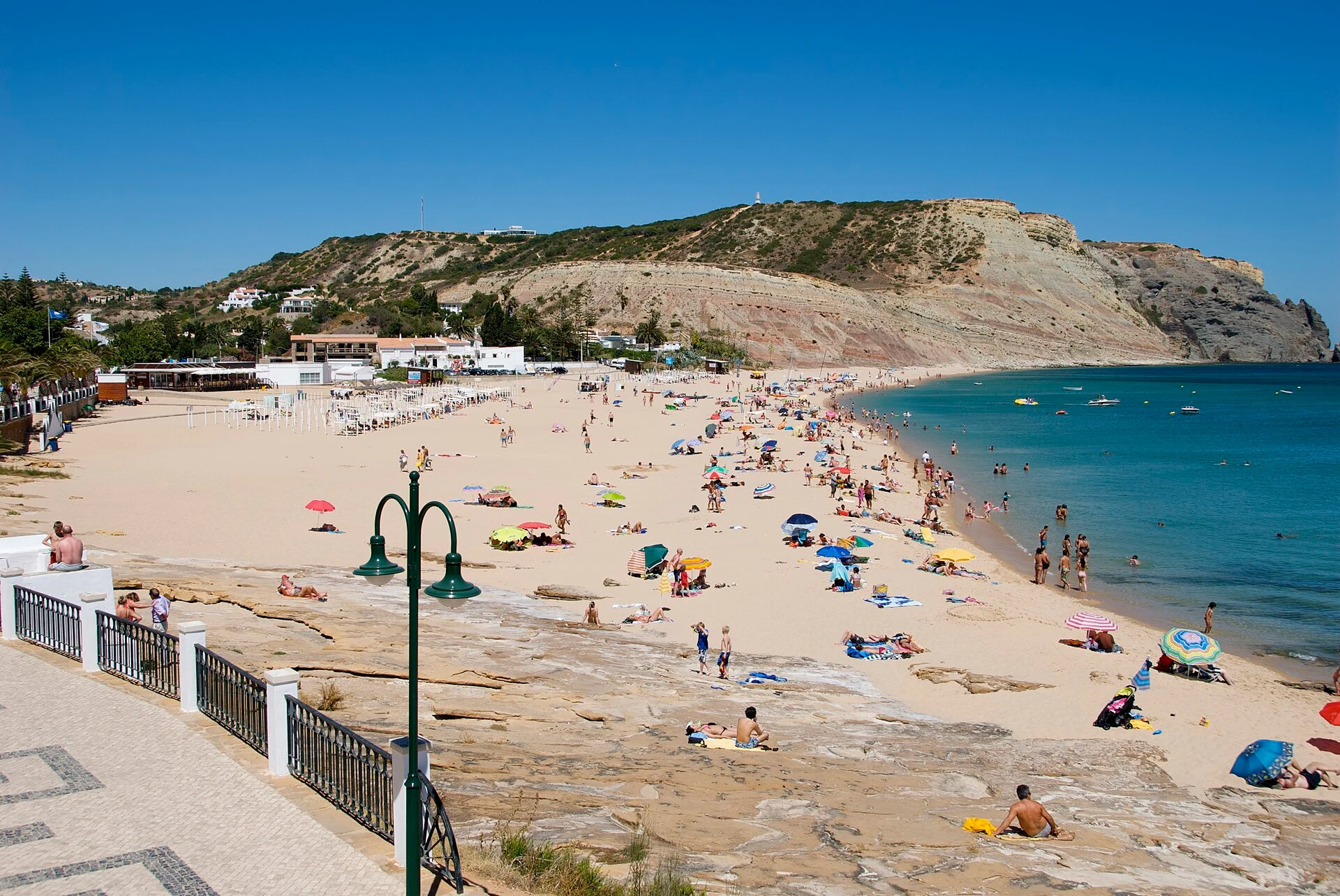
Praia da Luz is a wide, south-facing sandy beach sheltered between the Rocha Negra volcanic headland and the Fortaleza da Luz at the western end. Located 6 km west of Lagos in western Algarve, it is one of the region's best family beaches, with calm water, a palm-lined promenade, and the village right behind the sand.
Why This Beach
The Rocha Negra makes this beach. A dark volcanic headland at the eastern end, formed from basalt that cut through the Algarve’s typical sandstone cliffs around 150 million years ago, it gives Praia da Luz a visual anchor that no other beach on this stretch of coast has. The contrast is striking: golden sand, pale limestone cliffs to the west, and then this mass of dark rock jutting into the Atlantic.
But the real draw is practical. The bay faces south and sits sheltered between the Rocha Negra and the rocky point where the Fortaleza da Luz stands at the western end. That shelter means the water is reliably calm, shallow at the entry, and safe enough that families with small children treat it as their default beach. A palm-lined promenade runs the full length of the sand, lined with cafés and restaurants, so you can spend a full day without needing to go anywhere else.
Praia da Luz is not a dramatic cliffs-and-caves beach like Praia da Marinha or Praia de Benagil. It is not remote. The village is right there, visible from every spot on the sand. That is the point. This is a beach built around comfort and convenience, and it does both exceptionally well. Worth noting: the water is cold. Even at the height of summer, the Atlantic here stays bracing, typically around 19-21°C in July and August. The sheltered bay does not change that.
How to Get There
From Lagos, the drive takes about 10 minutes heading west. Follow the M537 towards Luz and you will arrive at the village, where signs point towards the seafront. Parking is free in several areas around the village, with paid spaces closer to the beach. In July and August, arriving before 10am makes the difference between parking near the promenade and circling residential streets for 15 minutes.
A local bus connects Lagos bus station to Luz. The ride takes roughly 25 minutes, and the stop is about a 5-minute walk from the sand.
From Faro airport, the drive is around 90 km west along the A22 motorway, then south towards Lagos and on to Luz. Allow about an hour.
Once you are in the village, getting onto the beach is easy. The promenade connects to the sand via ramps, including wheelchair-accessible ones, and there are no stairs or difficult paths to navigate. One of the most accessible beaches in the Algarve, and that is not an afterthought: the ramps, adapted facilities, and designated parking spaces are the reason it carries the “Praia Acessível” flag alongside the Blue Flag.
What to Bring and What to Know
Sun protection is the obvious essential. Shade on the beach itself comes from rented parasols or your own setup. There is no natural shade on the sand.
Bring water shoes if you plan to explore the rocks at either end. The tidal pools near the western rocks and around the base of the Rocha Negra are worth poking around, but the surfaces are uneven and slippery. The rock pools on the western end, near the Fortaleza, tend to be better for children.
Cash is not strictly necessary. Most of the promenade restaurants take cards. But the smaller vendors selling crafts and beach goods along the walkway may not.
A few things that set a day here apart from other Algarve beaches. Halfway along the promenade, tucked behind a small gate in the wall on Avenida dos Pescadores, there are Roman ruins: a bath complex and fish salting tanks dating from roughly the 3rd to 5th century. Free entry, open daily. Most people walk right past the gate without noticing it. Also at the western end, past the rocks, there is a small cove called Prainha. Quieter than the main beach, clear water, often half-empty even when the main stretch is packed.
The clifftop trail east from Rocha Negra leads towards Porto de Mós and eventually Praia Dona Ana and Ponta da Piedade. About 3 km to Porto de Mós. Good footwear matters here, not flip-flops.
Skip this if you want waves. The bay is too sheltered for surfing or bodyboarding. Water sports available in summer are the calm-water kind: pedal boats, kayaks, stand-up paddleboarding, banana boats.
Nearby Beaches
Praia Dona Ana is about 5 km east, just south of Lagos old town. Smaller, more photogenic, and framed by golden cliffs. It gets very crowded in summer, but the setting is hard to beat. Better for a half-day visit than an all-day stay.
Meia Praia stretches for 4 km east of Lagos marina. The opposite character to Praia da Luz: vast, open, and exposed. If you want space and do not mind a bit more wind, this is where to go. Easier to find room in peak season simply because of its length.
Porto de Mós sits between Luz and Lagos, about 3 km east along the clifftop trail. South-facing and less developed than Praia da Luz, with a good restaurant at beach level and a wider, more open feel. Slightly better waves, which is to say, still not much.
The eastern end of the beach, closest to Rocha Negra, stays less crowded than the centre even in August. At the western end, past the rocks near the fortress, there is a small cove called Prainha that most visitors walk right past.