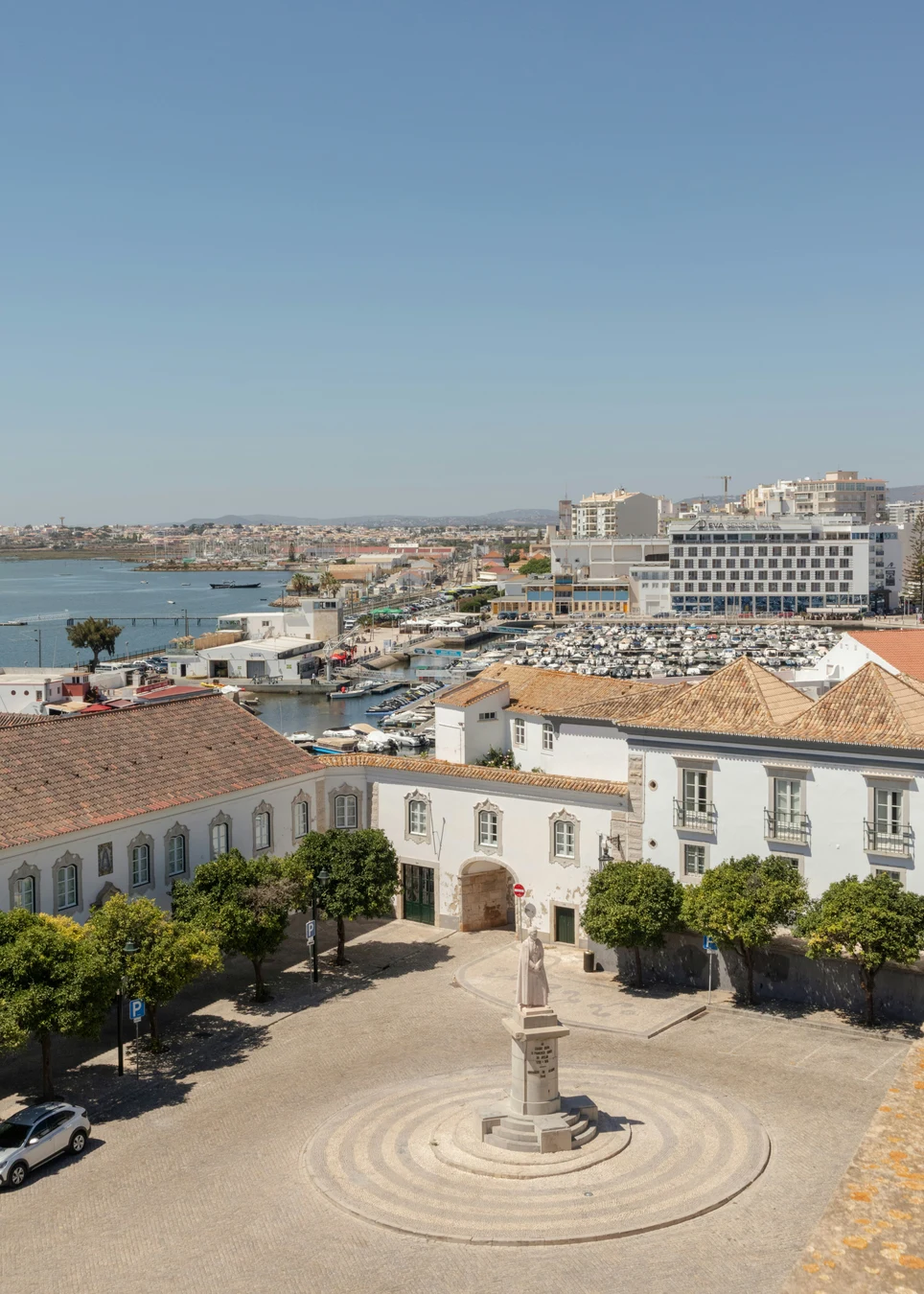
Faro is the capital of the Algarve and the region's main transport hub, with an international airport, train station, and bus network. Most visitors pass straight through to beach resorts, but the walled old town, Ria Formosa Natural Park, and a growing restaurant scene make it worth at least a full day.
Why Visit Faro
Faro is the town that nine out of ten Algarve visitors see only from a taxi window. They land at the airport, transfer west to Lagos or Albufeira, and never set foot in the actual capital of the region. Their loss.
The city has a compact walled old town that predates most of the resort infrastructure by several centuries. Inside those medieval walls, cobbled streets open onto quiet squares planted with orange trees, and buildings layer Gothic arches under Baroque facades under modern roof terraces. There’s a bone chapel made from the remains of over a thousand monks, a 13th-century cathedral with views from the bell tower that reach the barrier islands, and a municipal market where the fish was swimming a few hours ago. None of this requires a hire car or a full day of planning. You can walk from the train station to the old town in ten minutes.
The Ria Formosa Natural Park, a vast system of tidal lagoons and barrier islands, begins at Faro’s doorstep. Boat tours leave from the marina. Flamingos gather in the salt pans year-round (not a seasonal gimmick, they actually live there). And the food scene has been quietly evolving: Faro earned its first Michelin star in March 2026 when Alameda was recognised, and the traditional tascas were already strong long before that.
Faro does not compete with the western Algarve on beaches. It competes on character.
Best Things to Do in Faro
Walk the Cidade Velha
The old town sits behind medieval walls, entered through the Arco da Vila, an 18th-century neoclassical gateway built onto an original Moorish wall. Look for the storks nesting on top. Inside, the streets are narrow and mostly pedestrianised, lined with whitewashed buildings and the occasional crumbling facade that hasn’t been renovated yet. That mix of maintained and unfinished is part of the appeal: it feels like a real city, not a restoration project.
The Largo da Sé, the main square inside the walls, is where the cathedral, bishop’s palace, and town hall cluster together. Grab a seat at one of the cafés on the square if you want to watch the rare phenomenon of an Algarve town where locals outnumber tourists. The smaller Arco do Repouso, on the eastern side, leads to a quieter exit with views over the lagoon.
Climb the Sé Cathedral Bell Tower
The cathedral itself is a patchwork of styles spanning several centuries, and its interior includes hand-painted azulejo tiles and a gilded Baroque altar. None of that is the reason to come. The bell tower is. The climb is short, the steps are manageable, and the view from the top covers the rooftops of the old town, the harbour, and the Ria Formosa stretching south toward the barrier islands. On a clear day, you can pick out Ilha de Faro in the distance. Small admission fee.
Visit the Capela dos Ossos
Behind the Igreja do Carmo (itself worth entering for the gilded Baroque altar and ornate woodwork), a small chapel is constructed from the bones and skulls of over 1,000 Carmelite monks. The bones are not stored, they are the building material: arranged in geometric patterns across the walls and ceiling. An inscription above the entrance translates roughly as “Stop here and consider that you will reach this state too.” Not a hard sell. The whole visit takes about fifteen minutes. The church was badly damaged in the 1755 earthquake and took over a century to repair, which gives the complex a layered, slightly worn quality. Small admission fee.
Take a Boat Tour of the Ria Formosa
The Ria Formosa Natural Park covers over 18,000 hectares of saltwater lagoons, channels, marshes, and barrier islands along the coast. It is one of the most important wetland habitats in southern Europe, a stopover point for thousands of migratory birds. The practical version: you can book a two-hour boat trip from the Faro marina that loops through the lagoon channels, passes flamingo colonies in the salt pans, and drops you on a sandbar island for a swim. Longer full-day tours combine birdwatching with island-hopping. Kayak and SUP rentals are available for those who prefer to go at their own pace.
The islands on the seaward side of the lagoon, primarily Ilha Deserta, Ilha da Culatra, and Ilha do Farol, offer long stretches of beach that feel nothing like the resort-backed coastline further west.
Ferry to Ilha Deserta
Officially Ilha da Barreta, but everyone calls it Ilha Deserta. An uninhabited barrier island with kilometres of sand, one restaurant (O Estaminé, which runs on solar power and serves fresh seafood), and very little else. Ferries depart from the pier near the old town walls on Rua da Porta Nova. The southernmost point of mainland Portugal sits on this island, marked with a small sign that most people walk past without noticing. Worth the trip for anyone who wants a beach day without lounger-to-lounger proximity. In summer, boats run frequently; outside peak season, departures thin out.
Browse the Mercado Municipal
The market occupies a large modern building on Largo Dr. Francisco Sá Carneiro, open Monday to Saturday, typically 7:00 to 14:00. The ground floor is the main event: rows of fish vendors selling that morning’s catch (the variety is impressive, everything from sardines and sea bream to octopus and percebes), plus fruit, vegetables, cured meats, and local cheeses. A supermarket and several cafés operate in the lower levels and around the edges. Underground parking is available, which matters because the surrounding streets fill up fast.
Saturday mornings are the busiest and the best. The fish vendors start closing down by early afternoon, so come before noon.
Explore the Museu Municipal de Faro
Housed in a 16th-century convent near the cathedral, the museum covers archaeology from the Roman and Moorish periods through to paintings and religious art. It is small enough to see in an hour, and usually uncrowded. The Roman mosaic collection, including pieces from the nearby ruins at Milreu, is the strongest section.
Best Beaches Near Faro
Faro is not a beach town in the way Lagos or Albufeira are, but the barrier island system provides access to long, relatively quiet stretches of sand.
Praia de Faro is the closest option: a long sandbar island connected to the mainland by a bridge. The beach stretches over 5km and faces the open Atlantic on one side, the calm Ria Formosa on the other. Restaurants and facilities line the main section near the car park. It gets busy in summer but never feels as packed as the western cove beaches, simply because there is so much space. Bus route 16 runs from the city centre to the beach.
Ilha Deserta is the opposite experience. Accessible only by ferry, it offers long empty sand backed by dunes and the single solar-powered restaurant. No roads, no development beyond O Estaminé. If your idea of a beach day involves actual solitude, this is it.
Ilha da Culatra and Ilha do Farol, reachable by ferry from Faro or from nearby Olhão, have small fishing communities, a lighthouse, and beaches that see a fraction of the traffic of the western coast. The ferry ride itself is part of the appeal, crossing the lagoon channels with the Ria Formosa spreading out around you.
Where to Eat in Faro
The food in Faro runs a wider range than most visitors expect from an “airport town.” Traditional tascas serving generations-old recipes share the same streets as a newly Michelin-starred restaurant, and the Ria Formosa’s proximity means the seafood supply is about as direct as it gets.
Tasca do Ricky is the restaurant that locals mention first. Tiny, no-frills, run with visible passion by the owner. The seafood cataplana is the dish to order, along with the arroz de lingueirão (razor clam rice). It does not take reservations during peak season (May through September), and the space is small, so arriving before 19:30 is the only reliable strategy. Worth the wait.
Alameda, led by chef Rui Sequeira, earned Faro’s first Michelin star in March 2026. The tasting menu draws on Algarve ingredients and local folklore. Ria Formosa oysters, Tavira tuna, and seasonal vegetables from small producers feature throughout. An 8-course tasting menu with optional wine pairing. Open Thursday to Monday evenings and Sunday lunch. Closed Tuesday and Wednesday. Reservations essential, especially now.
Vila Adentro sits inside the old town walls in a former 18th-century azulejo tile factory. The setting alone is worth the visit, with original blue and white tiles across the walls. The menu is traditional Portuguese with a regional focus. The vegetarian cataplana, cooked in the signature copper pot, is a genuine surprise in a region that defaults to seafood in almost everything.
A Venda serves Portuguese petiscos (small plates) from an open kitchen on Rua do Compromisso. The menu changes daily. The slow-cooked pork cheek, mushrooms Bulhão Pato, and the blood sausage with orange segments have all been consistently good. Budget-friendly pricing: a carafe of house wine and several plates between two people won’t break the bank.
For something quick and cheap, Mister Frango on Rua Cruz das Mestras has the best chargrilled chicken in the city. Locals queue out the door for takeaway. The whole spatchcocked chicken is absurdly good for the price. Not atmosphere dining. Fuel.
Where to Stay in Faro
Faro’s accommodation scene has improved considerably in recent years but still leans mid-range. The city has one five-star hotel (3HB Faro, on a pedestrian shopping street near the centre, with a rooftop pool and views over the Ria Formosa), several solid four-star options, and a growing collection of boutique guesthouses and apartments.
Near the old town and marina is where most visitors should look. Hotel Faro (AP Eva Senses) sits directly on the marina with a rooftop restaurant and Ria Formosa views. The Faro Boutique Hotel and several apartment-style stays cluster around the pedestrianised shopping streets. This area puts you within walking distance of everything that matters, including the ferry pier for the islands.
For something with more character, several small guesthouses operate inside or just outside the old town walls. Rooms tend to be individually styled, breakfasts are served on rooftop terraces or in tiled courtyards, and prices stay well below what you’d pay in Lagos or Albufeira for equivalent quality.
Near the airport, the 3K Faro Aeroporto works for an early flight or late arrival, but there is no reason to base yourself out there otherwise. Praia de Faro has a handful of beach-facing options for those who want sand and water over old town access, though the selection is limited.
Faro is generally more affordable than the resort towns. Summer prices rise, but not to the levels you’ll find in Albufeira or Vilamoura, and availability holds better because fewer tourists think to stay here.
How to Get to Faro
Faro has the Algarve’s only international airport, receiving direct flights from cities across the UK, Germany, France, the Netherlands, and other European hubs. Airlines include Ryanair, easyJet, TAP Portugal, and British Airways, among others. The airport sits just 4km west of the city centre.
From the airport to the city centre: the Próximo bus route 16 runs from the airport to the bus station, contactless payment accepted. The ride takes about 20 minutes. Taxis line up outside arrivals. Uber and Bolt work but can hit surge pricing in summer when demand spikes at the terminal.
From Lisbon: Intercity (IC) and Alfa Pendular (AP) trains run from Lisbon’s Estação do Oriente to Faro, taking between 3 and 3.5 hours. Book early online through CP (Comboios de Portugal) for discounts of up to 65%. The Rede Expressos bus service is an alternative at roughly 3.5 hours, with departures from Lisbon’s Sete Rios terminal.
From other Algarve towns: the regional train line runs the length of the coast from Lagos to Vila Real de Santo António, with Faro at the midpoint. For towns east of Faro (Olhão, Tavira, Vila Real), the train is the better option, with stations close to the centres. For western destinations (Albufeira, Portimão), the bus is often more practical because train stations sit kilometres from the tourist areas. The exception is Lagos, where the train station is central. Both the bus and train stations in Faro are on Avenida da República, less than five minutes’ walk apart.
One critical detail: the last bus and train departures from Faro to other Algarve towns leave between 19:00 and 20:00. There is no late-night public transport. If you arrive on an evening flight, either pre-book a private transfer, use a taxi or Uber, or plan to spend the night in Faro.
Local Tips
The city centre is compact and flat, making it one of the most walkable towns in the Algarve. Everything within the old town walls takes minutes to cross on foot, and the main shopping streets, marina, and market are all within a ten-minute radius. Bikes are available for rent from several operators near the marina if you want to cover more ground, particularly along the waterfront toward the university campus.
Faro is noticeably quieter than the resort towns, and that extends to its daily rhythm. The old town empties out by late evening on weekdays. The liveliest area after dark is Rua do Prior and the streets around it, where a handful of bars and wine spots draw a mixed local and university crowd. Se7e Pedras, on Travessa dos Arcos, is a wine bar with a changing menu and outdoor seating in a lantern-lit alleyway. Grains 864, across the lane, pours craft Portuguese beers.
The Mercado Municipal is the best place to buy food if you’re self-catering, and the fish counter alone is worth a visit even if you’re not. Saturday mornings are the most animated. Go before 11:00. The Gypsy Market (Feira da Boavista) takes over the streets near Largo de São Francisco on the first Saturday of each month, with second-hand goods, clothing, and general chaos. Cash only. Bring small notes.
Estoi Palace, a 19th-century Rococo palace about 10km north of the city, and the Roman ruins at Milreu, roughly the same distance, make a good half-day side trip if you have a car. Neither attracts heavy tourist traffic. The palace gardens are free to enter.
The last bus and train departures from Faro to other Algarve towns leave between 19:00 and 20:00. If you arrive on an evening flight, plan to stay the night in Faro rather than scrambling for transport to your resort.