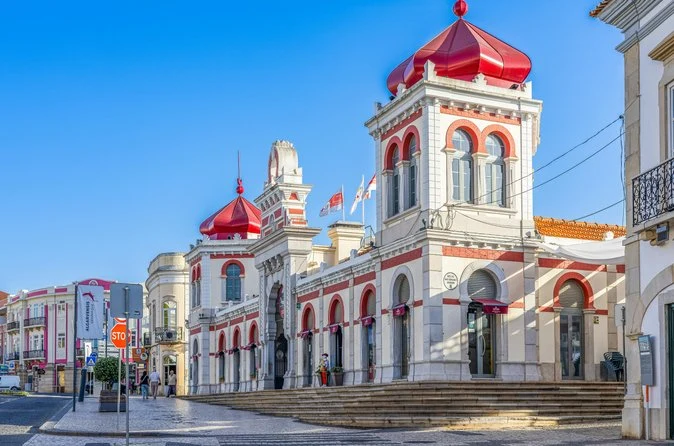
Loulé is an inland market town in the central Algarve, about 20 minutes north of Faro. Its neo-Moorish market hall is the most famous in the region, the parish church bell tower is the only surviving mosque minaret in Portugal, and guided tours descend 230m into a working salt mine beneath the town.
Why Visit Loulé
Loulé is the Algarve’s best reason to leave the beach for a morning. This is a proper Portuguese market town, not a coastal resort, and the difference shows in everything from the pace of the streets to the price of lunch. The Mercado Municipal, with its neo-Moorish arches and red domes, is the most photographed market building in the region. But the town around it has its own pull: a 13th-century castle with excavated Moorish ruins beneath a glass floor, a church whose bell tower is the only surviving mosque minaret in Portugal, working coppersmith workshops on medieval back streets, and, beneath it all, a salt mine where guided tours drop you 230m underground.
About 20 minutes north of Faro, Loulé sits at the point where the flat coastal plain starts rising toward the hills. The municipality is enormous (it technically includes Vilamoura and Quarteira within its borders), but the town itself is compact and walkable. Most visitors come for a Saturday morning and leave by lunch. That’s enough if time is tight, but a slower weekday visit catches the town in a different mood. Quieter, more itself, and easier to park.
Best Things to Do in Loulé
Mercado Municipal de Loulé
The market is the anchor, and it earns the reputation. The building alone would be worth seeing: designed by Alfredo Costa Campos and opened in 1908, with horseshoe arches and ceramic tilework under those red domes that appear on every Loulé postcard. A major renovation in 2007 preserved the historic character while modernising the interior. Inside, permanent stalls sell fish, meat, cheese, fruit, dried fruits, honey, and local spirits.
Saturday mornings are the main event. A farmers’ market sets up around the outside of the building, and vendors from across the region bring produce, bread, flowers, spices, and regional products. The crowds peak between about 9 and 11. Arriving earlier gives you the best selection and fewer elbows.
Weekday mornings are a different experience entirely. The indoor market operates as normal (closed Sundays) but without the Saturday crush. The quality of the permanent stalls is just as high, and you can actually talk to the vendors.
Mina de Sal-Gema (Rock Salt Mine)
Beneath the streets of Loulé sits a working salt mine with over 45km of galleries, and you can visit it. A mine elevator drops 230m underground (the descent takes about three minutes in a cage that fits five people at a time) into a network of tunnels where 230-million-year-old geological formations line the walls. The two-hour guided tour follows a 1.3km interpretation route through the mine, covering the history of salt extraction and the geology of the deposit. Temperature inside is a stable 23-24°C year-round. Comfortable shoes and a willingness to ride a slightly unnerving elevator are the main requirements.
Tours typically run on weekdays; check locally for current tour times and availability. Advance booking is recommended but not always essential. Children under six are not admitted, and those aged six to twelve must be accompanied by an adult. It is the deepest tourist site in Portugal, and one of the most unusual things to do anywhere in the Algarve.
Castelo de Loulé and Municipal Museum
The castle formed the northwest corner of the medieval town walls. The site has been occupied since at least the 2nd century (Roman fortification first, then Moorish), but the three towers and connecting walls you see today were built after Dom Paio Peres Correia took the town from the Moors in 1249. The 1755 earthquake caused serious damage; restoration work in the 1940s brought the towers and walls back into shape.
The Municipal Museum occupies the Alcaidaria, the former governor’s residence within the castle grounds. Exhibits cover Bronze Age, Roman, and Moorish-era archaeology found in the area. The standout feature is a glass floor over excavated Almohad-era structures, including remarkably well-preserved Islamic public baths dating to the 12th century, with the vestibule, hot room, tepid room, and cold room still identifiable. A reconstruction of a traditional Algarve kitchen (Cozinha Tradicional Algarvia) is also part of the visit. The castle courtyard is free to enter. The museum is open Tuesday to Saturday and charges a small admission fee.
Igreja Matriz de São Clemente
The 13th-century parish church sits at the eastern edge of the old town and contains the most historically significant structure in Loulé. The bell tower is a converted minaret from the mosque that stood on this site before the Christian reconquest. It is the only surviving mosque minaret in Portugal. The church itself was named for Saint Clement because the town was taken on 23 November 1249, his feast day.
Beyond the Gothic portal, the interior reveals columns of varying heights thought to be repurposed from Roman or Arab buildings. The capitals display intricate leaf carvings, possibly the work of Muslim craftsmen who remained after the reconquest. Across from the church, the Jardim dos Amuados (a name that translates roughly to “Garden of the Sulky”) was a Muslim burial ground, then a Christian cemetery, and is now a garden with views over the surrounding area.
Capela de Nossa Senhora da Conceição
Directly opposite the castle entrance, this small 17th-century hermitage conceals an interior that catches most visitors off guard. Behind the plain exterior, the walls are covered in azulejo tile panels depicting biblical scenes, with gilded altarwork and detailed carvings. Free entry and genuinely worth stepping inside for a few minutes.
Old Town Craft Workshops
Loulé’s old town, centred around the narrow cobbled streets of Rua Almeida Garrett, preserves something increasingly rare in the Algarve: working artisan workshops that are not staged tourist experiences. Copper workers and leather craftspeople operate from small studios that open directly onto the lanes, with palm-leaf weavers carrying on their own tradition nearby. The copper work is the most distinctive tradition here. You can watch pieces being shaped and buy directly. The town council has made efforts to preserve these workshops, which is one reason they still exist when equivalent traditions in other towns have quietly disappeared.
Loulé Carnival
Portugal’s oldest carnival celebration, running annually since 1906. The parades take place over three days (Sunday through Shrove Tuesday) along Avenida José da Costa Mealha, with a different satirical theme each year. Elaborate floats carry giant caricature figures lampooning politicians and current events, accompanied by samba music and hundreds of costumed performers. Over 600 participants and a dozen or more floats typically take part. A children’s carnival is held separately on the preceding Thursday.
Parades run from 3pm to 6pm each day. If your trip overlaps with carnival dates (February or early March, depending on the year), rearrange your schedule. If it doesn’t, the rest of Loulé’s appeal runs year-round.
Festival Med
A world music festival held annually since 2004, transforming the historic centre into an open-air concert venue over four days in late June. In 2026 the festival runs 25-28 June, with the final day an Open Day with free admission. Five main stages (including one inside the castle) host 50+ concerts from artists spanning 30 countries, with street food stalls, craft markets, and performances filling the old town streets from 8pm to 4am. It is comfortably the biggest summer cultural event in the central Algarve.
Best Beaches Near Loulé
Loulé has no coastline of its own, but the beach is never far. The closest stretch of coast is about 15-20 minutes south by car.
Praia da Falésia is the standout option, a long stretch of sand backed by striking red and orange sandstone cliffs running between Vilamoura and Olhos de Água. The cliff colours are genuinely dramatic, and the beach is long enough that walking ten minutes in either direction from any access point usually finds you space even in high summer.
Quarteira has a simple, long town beach directly on the seafront promenade. Not spectacular, but functional and right next to restaurants and cafés. Good for an afternoon swim after a morning in Loulé without making a production of it.
Vilamoura’s beach, near the marina, is well-serviced and has a more upmarket feel. The sand is good and the facilities are reliable.
Sea temperatures along this central stretch of coast reach around 21-23°C in August, comfortable for swimming from June through September. By May the water sits at 17-18°C, manageable if you commit to it quickly.
Where to Eat in Loulé
Loulé’s restaurant scene punches above what you’d expect from an inland town of this size. It draws a regular lunch crowd from Faro and the coast, and the cooking leans more traditionally Portuguese than the seafood-dominated coastal spots. More meat, more stews, more of the interior Algarve cooking that visitors who stick to the beach towns miss entirely.
CaféZique is the most ambitious restaurant in town. Chef Leandro Araújo holds a Michelin Bib Gourmand for his gourmet petiscos: traditional Algarve flavours (fig, cured fish, local cheese, pork from the surrounding hills) handled with precision and occasional unexpected twists. The multilevel space with rooftop terraces overlooking the old town is as much a reason to visit as the food. Sharing plates are the format. Reservations are a good idea, particularly at weekends.
Café Calcinha, on Praça da República, has been open since 1929 and is one of Portugal’s 38 official Historic Cafés. The Belle Époque interior with Brazilian wood fittings was restored in 2017. A bronze statue of the poet António Aleixo, a regular in his day, sits outside on the terrace. The Folhado de Loulé, a regional puff pastry sweet specific to this town, is the thing to order here. Daily specials are budget-friendly and substantial, though the appeal is as much about sitting in this particular room and watching the square through the window.
For straightforward grilled chicken, Churrasqueira Leonel has a justified local following. The frango no churrasco (piri-piri chicken) is the main event, and the lunchtime queue outside confirms it. Takeaway moves faster if you just want the chicken and chips. Churrasqueira Angolana, on Rua de Nossa Sra. da Piedade, adds Angolan influence to its charcoal-grilled meats and fish, and fills with locals most evenings. Half-portions are available, which helps if you want to sample more than one thing without committing to the volume that Portuguese portion sizes usually demand.
Where to Stay in Loulé
Most visitors treat Loulé as a day trip, and that makes sense: the coast is 15-20 minutes away and the town is quiet after dark outside of festival periods. But staying a night or two opens up a different experience, particularly if you want the Saturday market without an early drive, or if you’re timing a visit around the Carnival or Festival Med.
The old town has a few small guesthouses and boutique options, some in converted traditional buildings. These put you within walking distance of everything and tend to be good value compared to equivalent accommodation on the coast. Prices drop noticeably outside July and August.
The surrounding countryside has quintas and rural tourism properties scattered among the orange groves and quiet roads between Loulé and the hills to the north. A different proposition: you’ll need a car, but you get pools, gardens, and a base that feels removed from the tourist circuit. For those who want resort amenities with Loulé as a day trip, Vilamoura is a 15-minute drive south and has hotel options at every price point.
How to Get to Loulé
Loulé is about 20 minutes north of Faro Airport, making it one of the most accessible inland towns in the Algarve. The A22 motorway (toll-free since January 2025) takes you most of the way; the turn-off is clearly signed. The alternative is the N125-4 through Almancil, slightly slower but straightforward.
From other towns in the Algarve, drive times are short: Albufeira is about 20 minutes west, Vilamoura about 15 minutes south, Silves about 30 minutes northwest. From Lagos, count on about an hour.
Bus services connect Loulé to Faro, Quarteira, Vilamoura, and Albufeira. The bus station sits on the edge of the old town, a short walk from the market. Loulé also has a train station on the regional Algarve line, but it sits a couple of kilometres outside the centre with no convenient connection into town. The bus is more practical.
Parking is manageable on weekdays. On Saturday mornings, when the market draws crowds and coach groups, spaces near the centre fill early. Arriving before 9am helps. Free street parking is available on the roads surrounding the old town; a few small paid car parks are closer in.
Local Tips
The Espírito Santo convent complex, now housing the town hall and municipal art gallery, has a 200-year-old Norfolk Island Pine standing in its central cloister. At roughly 45m tall, it towers over every other building in Loulé and is visible from across town. Worth a glance when you’re passing between the market and the castle.
Avoid Sundays and Mondays for a Loulé visit. The market closes on Sundays, and on Mondays the castle museum and most government-managed attractions shut their doors. Tuesday to Friday gives you everything open without the Saturday crowds. Saturday morning is the most atmospheric experience, but come early and accept the parking situation.
The town comes alive in very different ways twice a year. Carnival in February or March turns the main avenue into a street party with three days of satirical parades. Festival Med in late June transforms the entire historic centre into an open-air world music venue for four nights running past 4am. Both sell the town out. If you’re planning to stay overnight during either event, book well in advance.
If you’re visiting in summer, the salt mine tour is worth considering for more than the novelty. At 230m underground and a constant 23-24°C, it’s the most comfortable two hours you’ll spend in the Algarve when the surface temperature is pushing 30°C.
Avoid Sundays and Mondays. The market closes on Sundays, and the castle museum and most government-managed attractions close on Mondays. Tuesday to Friday gives you everything without the Saturday crowds.