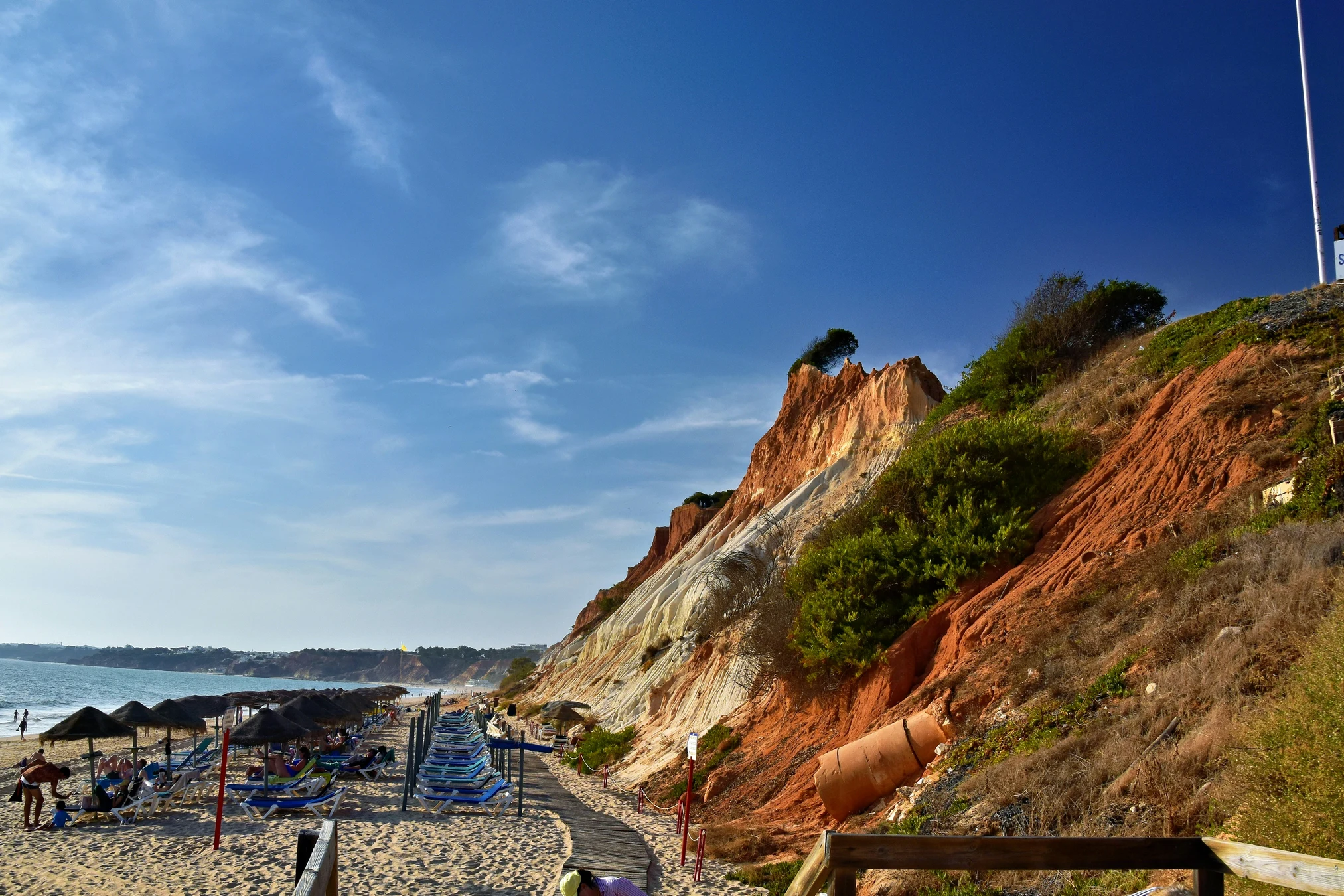
Praia da Falésia is a 6km stretch of golden sand between Olhos de Água and Vilamoura in the central Algarve, backed by red, orange, and white clay cliffs up to 40 metres high. It holds Blue Flag certification and was ranked the world's best beach by TripAdvisor in 2024. The beach has three main sections: the scenic western cliffs near Olhos de Água, the central Açoteias access point, and the wider eastern stretch towards Vilamoura with water sports and beach restaurants.
Why This Beach
Falésia is the Algarve’s answer to the question nobody asks at the crowded cove beaches: what if you could just keep walking? Six kilometres of unbroken sand, backed by clay cliffs that shift from deep terracotta to chalk white depending on the section and the time of day. The name means “cliff” in Portuguese, and the cliffs are the reason the beach exists in its current form. Their fragility has blocked any development directly behind the sand, which means long stretches with no buildings, no beach bars, no sun-lounger operators. Just cliff, sand, and Atlantic.
The character changes as you move along it. The western end near Olhos de Água has the tallest cliffs, roughly 40 metres, and the most dramatic colour. The central Açoteias section is where most day-trippers end up: lifeguards, a snack bar at the top, and sun-lounger rental on the sand. Head east and the cliffs shrink, the beach widens, sand dunes replace rock, and you eventually hit the Vilamoura end with its trendy beach restaurants and water sports. A completely different beach depending on which section you choose, and all connected by the same strip of sand.
TripAdvisor named it the world’s best beach in 2024. That kind of award usually signals overcrowding, but the sheer length of Falésia absorbs the attention. Even in August, a five-minute walk from any access point gets you to near-empty sand.
How to Get There
The main access for a day trip is the Açoteias entrance, roughly 15 minutes by car from central Albufeira. Follow signs towards Açoteias or Aldeia das Açoteias. The road (Rua da Falésia) leads to a free clifftop car park. In summer, this lot fills before mid-morning, so plan for an early start or accept a longer walk from overflow parking.
From the car park, a wooden staircase of about 70 steps takes you down to the sand. Platforms with benches break up the descent. Not difficult for most people, but worth considering if mobility is limited.
Vamus bus number 8 runs from Albufeira’s bus station toward the Falésia area. The service is infrequent. Relying on it for a precise schedule will test your patience, and from the bus stop you still need to walk down Rua da Falésia to reach the beach. A taxi or Bolt from Albufeira removes the guesswork.
The Vilamoura end offers flat, boardwalk access with no stairs. Paid parking on Avenida Rocha Baixinha adds up on a full beach day. Free parking exists further into Vilamoura, but you’ll walk 15 to 20 minutes. Alternatively, from central Vilamoura it’s about 1.3km on foot around the marina to the eastern beach, a pleasant route if you’re already based there.
There’s also a clifftop viewpoint, Miradouro da Falésia, near the Açoteias access. Worth a stop before heading down, particularly in late afternoon when the light turns the cliffs copper.
What to Bring and What to Know
The snack bar at the Açoteias access is small and basic. If you want a proper lunch, bring your own or plan to walk east towards the Vilamoura end, where beach restaurants like NoSoloÁgua and My Al Mar serve food at resort prices. No restaurants sit directly on the sand in the central section.
Sun-loungers and parasols are available for rent at Açoteias, but only in the immediate area around the staircase. Walk a few minutes in either direction and there’s nothing. No shade at all (the cliffs face south and don’t cast useful shadow until very late in the day). Bring your own parasol if you plan to sit anywhere other than the main access zone.
The water stays cool even in summer, reaching around 20-22°C in August on this central stretch of coast. Refreshing is the polite word. The Atlantic here doesn’t warm up the way the eastern Algarve does around Tavira, and the difference is noticeable.
High tide pushes the water right to the cliff base at some points along the western end. Check tide times before setting off on a long walk towards Olhos de Água. Getting caught between cliff and surf is a real annoyance, not a danger exactly, but you’ll get soaked and have to backtrack. The eastern half is much wider and doesn’t have this problem.
Wind can be a factor. The beach faces south but has little shelter from westerlies along the open central section. Mornings tend to be calmer. A surf school operates at Açoteias (Albufeira Adventure), and the waves along this stretch are better for learning than the short cove beaches further west. At the Vilamoura end, Nautic Drive offers jet-skiing, parasailing, and wakeboarding for those who want engine noise with their Atlantic.
Nearby Beaches
Praia de São Rafael is a sheltered cove about 15 minutes west by car, closer to central Albufeira, with good snorkelling and calmer water, if you prefer a contained beach over an open stretch.
Praia dos Olhos de Água sits at the western tip of Falésia, technically a separate beach with its own small-town feel, natural freshwater springs visible at low tide in the rocks, and more restaurant options right on the sand.
Praia da Rocha Baixinha is the eastern extension of Falésia towards Vilamoura, often listed separately. Wider sand, lower cliffs, and the concentration of beach clubs and water sports make it feel more like a resort beach than the wild central section.
Walk 5 minutes in either direction from the Açoteias staircase and the beach empties out. Most visitors cluster within 100 metres of the access point, even in August, because the staircase feels like the only way down.