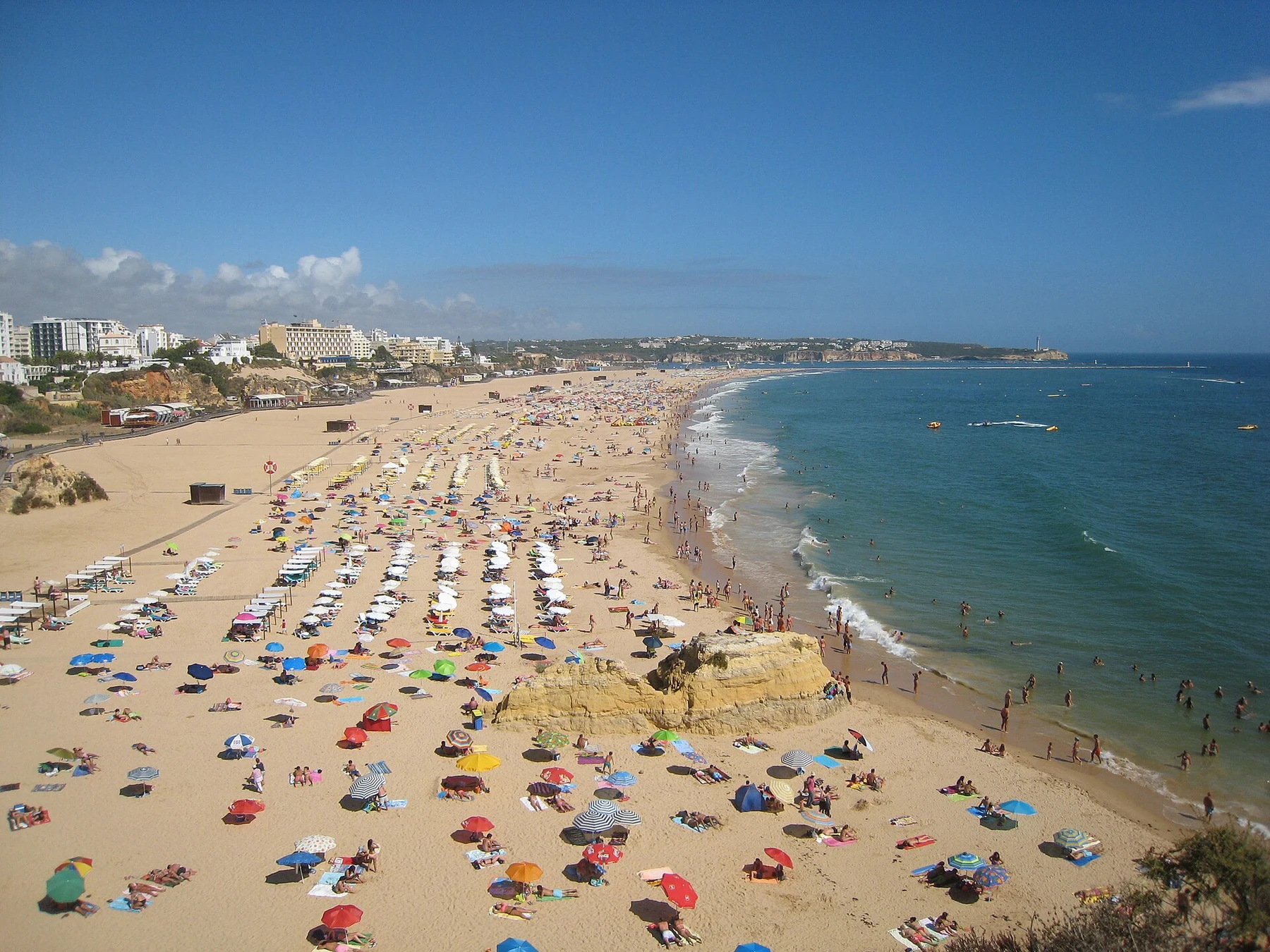
Praia da Rocha is the main beach in Portimão, stretching over 1 km of wide golden sand beneath ochre-coloured cliffs. It is one of the Algarve's most developed beaches, with a full boardwalk of restaurants and bars, lifeguard cover in summer, wheelchair-accessible walkways, and the 17th-century Fort of Santa Catarina at its eastern end.
Why This Beach
Praia da Rocha is the Algarve’s most built-up beach, and it does not pretend otherwise. The skyline behind the sand is apartment blocks and hotels from the 1980s and 90s, closer to the Costa del Sol than to the wild cove beaches further east. That is precisely the trade-off: you lose the raw, untouched coastline, and in return you get a kilometre-plus of wide golden sand with a restaurant, a bar, or a sun lounger rental within a two-minute walk at any point. For visitors who want convenience above all else, few Algarve beaches compete.
The beach itself is the redeeming feature. Ochre and rust-coloured cliffs frame both ends, and rock formations punctuate the sand, giving it more visual character than the typical resort beach deserves. The Fort of Santa Catarina, a 17th-century fortress built to guard the mouth of the Arade River, sits at the eastern edge and is worth the ten-minute walk from the main access points. At the western end, the Três Castelos viewpoint gives a panoramic sweep of the full stretch. Between those two endpoints runs a wooden boardwalk connecting beach bars, sports areas, and a social scene that ramps up hard in July and August. Off-season, the same stretch is popular with retirees and locals doing morning walks along the sand, and the boardwalk bars are half-shuttered. Two very different beaches depending on when you show up.
How to Get There
Praia da Rocha sits about 3 km south of Portimão city centre. By car from the A22 motorway, take the Portimão exit and follow signs south to Praia da Rocha along the main road, which becomes Avenida Tomás Cabreira as it runs along the clifftop above the beach.
Parking depends on the season. From June to September, street parking along the Avenida is metered (active 9am to midnight), and spaces fill quickly. The underground car park on Rua Dom Martinho Castelo Branco is the most central paid option, with around 280 spaces. The better-value option is the large free dirt car park near the marina roundabout on Estrada da Rocha, which holds roughly 1,000 cars. It is about a 10-minute walk to the sand. Not glamorous, but free. From October to May, the pay-and-display machines along the main streets are switched off and parking is generally free throughout.
Public transport works here, which is unusual for Algarve beaches. The Vai e Vem bus 33 runs from Portimão city centre to the fort at the eastern end of the beach. Bus 11 also reaches the beach but runs only once per hour. From Faro Airport, the VAMUS Aerobus 56 goes to Portimão bus station, where you can connect to the local service.
From Portimão city centre, the walk takes about 25 minutes, mostly downhill heading south.
What to Bring and What to Know
The sand gets hot. Genuinely hot, the kind where you need flip-flops or you will regret it by mid-July. Bring them.
Sun lounger and parasol rental is available along most of the beach, so you do not need to haul your own shade. The boardwalk restaurants and bars mean you can eat and drink without leaving the beach, though prices along the sand are tourist-level. For cheaper food, the streets one block back from the Avenida have more reasonable options (and better Portuguese food, frankly).
Wind can be a factor. The beach faces south but catches westerly winds, and some visitors report conditions turning breezy in the afternoon, particularly at the western end. The eastern end near the river mouth is more sheltered. If the wind picks up and the main beach becomes uncomfortable, Praia dos Três Castelos on the other side of the western rocks is often calmer thanks to the cliff shelter.
Water sports are available in summer: banana boats, parasailing, kayaks, and jet skis operate from the beach. Surfing is possible but inconsistent. The best waves tend to come between September and March, and in summer the beach is too crowded for it to be practical or safe.
Dogs are allowed on the beach during winter (roughly November to April) and outside lifeguard hours in summer, generally before 9am or after 7pm.
One thing that catches people off guard: Praia da Rocha has a significant nightlife scene. Avenida Tomás Cabreira is lined with bars, clubs, and a casino (the Algarve Casino inside the Hotel Algarve Casino). In July and August, the area around the beach has a party atmosphere that runs well past midnight. Good to know if you are travelling with young children and booking a hotel on the strip, or if you are in your twenties and that is exactly what you want.
Nearby Beaches
Praia dos Três Castelos is immediately west, connected by a tunnel through the rock formations, and has dramatic limestone stacks standing in the water with a fraction of the crowds.
Praia do Vau is a 15-minute walk further west along the coast, smaller and more relaxed, with calmer water that suits families with younger children.
Praia dos Careanos continues the westward chain, backed by interesting rock formations and noticeably quieter even in peak season.
Praia Grande sits on the eastern side of the Arade River estuary, a large stretch of sand that feels like a different world despite being just across the water, accessible via Ferragudo.
The western end near the Três Castelos rock formations is the most crowded section. Walk east towards the fort for noticeably more space, and a tunnel through the rocks at the western end connects directly to the quieter Praia dos Três Castelos if you want to escape the boardwalk energy entirely.