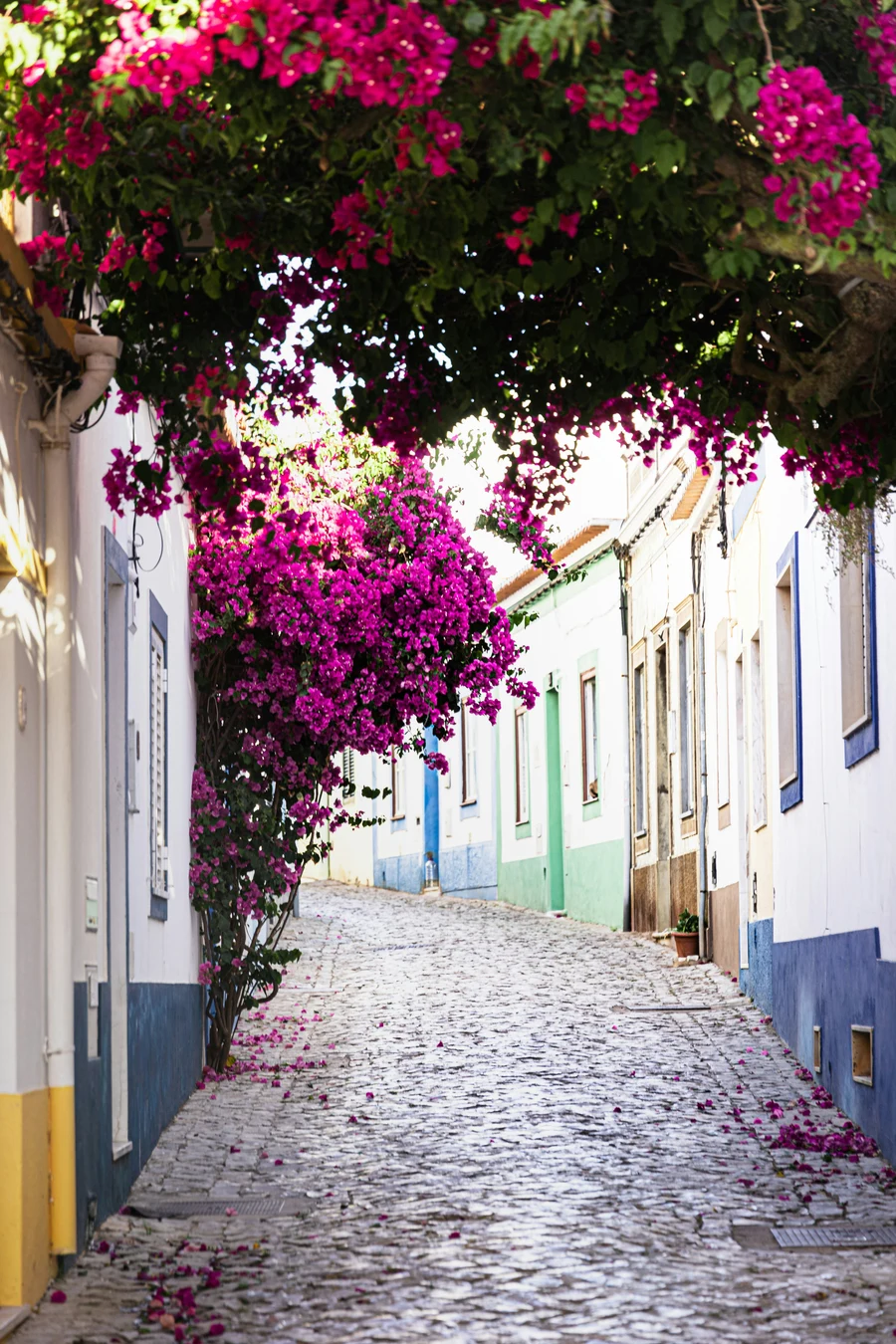
Ferragudo is a small fishing village on the Arade River estuary, directly opposite Portimão in the central Algarve. It has escaped the heavy development of its neighbours, keeping a traditional character with whitewashed streets and a harbourside square. The restaurant scene is surprisingly strong for a village this size.
Why Visit Ferragudo
Ferragudo sits across the Arade River from Portimão, close enough to see the high-rises of Praia da Rocha from its harbour wall. The contrast is the point. Where Portimão sprawled into a city and Praia da Rocha became a full-scale resort, Ferragudo stayed small. Whitewashed houses climb a hillside. A 17th-century fortress divides two beaches. Fishing boats still come and go from the harbour, and the main square has more restaurants than it reasonably should for a village of around 2,000 people.
There is no big attraction here. No famous landmark that draws tour buses. The appeal is the texture of the place: cobbled streets steep enough to make your calves work, bougainvillea spilling over walls, a church terrace with views that cost nothing, the smell of grilled fish drifting from somewhere you haven’t found yet. People come to Ferragudo for a long lunch and a walk along the cliffs, and most of them leave wondering why they booked a hotel somewhere busier. The village sits in the municipality of Lagoa (the same as Carvoeiro, which is about 10 minutes east by car) and benefits from being close to everything without being in the middle of anything.
Best Things to Do in Ferragudo
Walk the Harbour and Praça Rainha Dona Leonor
Start at the waterfront. The harbour is where the fishing boats dock, and in the morning you can watch the day’s catch being sorted. Rua Infante Dom Henrique runs along the water from the harbour towards the beaches, and the main square, Praça Rainha Dona Leonor, is a few steps inland. The square is ringed by restaurants with outdoor tables. Not the most atmospheric dining in the Algarve, honestly, but a decent spot for a coffee and some people-watching while you get your bearings.
Forte de São João do Arade
The fortress sits on a rocky headland between Praia da Angrinha and Praia Grande, guarding the mouth of the Arade. A watchtower stood here as early as the 15th century; the current structure dates from 1644, built after Portugal regained independence from Spain and needed to defend the river entrance alongside the Forte de Santa Catarina on the Portimão side. It is privately owned and closed to visitors, which is frustrating given its position. You can admire it from Praia da Angrinha at close range, and the exterior alone is worth the walk.
Igreja de Nossa Senhora da Conceição
Follow the steep cobbled streets uphill and you reach Ferragudo’s church, sitting at one of the highest points in the village. The building itself is modest. The reason to come is the terrace in front: panoramic views across the Arade estuary to Portimão, out to sea, and down to Praia da Angrinha with the fort below. There are shaded benches in the small gardens beside the church. Quiet in a way the waterfront rarely is.
Trail of the Headlands
The best half-day walk on the central Algarve coast. The trail runs about 6km along the clifftops from Praia Grande south towards Carvoeiro, passing the Ponta do Altar lighthouse (dating from 1893), several tiny cove beaches that can almost disappear at high tide, and the more substantial Praia dos Caneiros. Interpretive panels along the route explain the geology and coastal vegetation. The path is well-marked and mostly flat once you clear the initial climb from Praia Grande, though a few sections near the cliff edge demand attention with children. Bring water; there is no shade for long stretches.
Water Taxi to Portimão
Not exactly a “thing to do” in the traditional sense, but the crossing is worth taking even if you have a car. The water taxi runs from Ferragudo’s harbour to Portimão marina (near Praia da Rocha) and takes about 10 minutes. Summer hours extend into the evening. It is the best way to combine Ferragudo with a visit to Portimão’s riverside promenade or the Portimão Museum without dealing with parking on both sides of the river.
Praia dos Caneiros
Reachable on foot via the Trail of the Headlands or by a short drive south from the village, Praia dos Caneiros is a cove beach set between cliffs with a character very different from the town beaches. The well-known restaurant Rei das Praias is built into the cliff face here, and Club Nau operates as a beach bar on the sand. More secluded, more dramatic, and worth the slight extra effort to reach.
Best Beaches Near Ferragudo
Ferragudo has its own beaches within walking distance, which most visitors don’t expect from a village this small.
Praia Grande is the main beach: a wide stretch of golden sand just south of the fortress, with calm water, lifeguards in summer, and beach bars. Good for families. The walk from the village centre takes about 10 minutes.
Praia da Angrinha is on the other side of the fort, facing the Arade estuary. Smaller and quieter, with views across to Portimão. You’ll see fishermen here rather than tourists, especially in the morning. No facilities to speak of.
Further along the coast, Praia do Pintadinho and Praia dos Caneiros are accessible via the clifftop trail. These are small cove beaches tucked between limestone formations, more scenic and more exposed. Check the tide before heading out, as some of them shrink to almost nothing at high water.
For a bigger, more developed beach, Praia da Rocha is directly across the river, reachable by water taxi or a short drive over the bridge.
Where to Eat in Ferragudo
The restaurant scene is the thing that surprises people about Ferragudo. A village this size should have a couple of tourist-facing fish places and nothing else. Instead, there are enough good options to eat well for several days without repeating.
The harbourside restaurants on Praça Rainha Dona Leonor do a reliable job with grilled fish and local dishes. Borda do Cais is the straightforward choice here: fresh catch, simply grilled, no unnecessary embellishment. It is exactly what you want from a Portuguese fish restaurant, and the harbour setting does the rest. Sueste, also on the quayside, takes a similar approach but the staff make more of a show of presenting the day’s fish before you order. Worth it for the sea bass.
A street back from the waterfront, A Ria is the restaurant locals mention first. The monkfish and prawn rice is the signature dish, and there’s a reason people keep coming back to it. The space is small, so booking in summer is close to essential.
For something different, V5 Petiscaria & Bar does Portuguese small plates (petiscos) at prices that feel almost unfair given the quality. The menu shifts with what’s available. A few plates, a glass of wine, an unhurried evening. Not every meal in the Algarve needs to be grilled fish, and this place proves it.
Down at Praia dos Caneiros, Rei das Praias has a dramatic cliffside position and serves seafood in a setting that justifies its slightly higher prices. It is more of an occasion restaurant than an everyday lunch spot.
Where to Stay in Ferragudo
Ferragudo has no large resort hotels, and that is entirely the point. Accommodation runs to rental apartments, villas, and a handful of smaller hotels and guesthouses. The village itself is compact enough that location matters less than in bigger towns: anywhere in the centre puts you within a 10-minute walk of the harbour, the square, and the beaches.
For a hotel option, Hotel Casabela, a 4-star property near Praia Grande with sea-facing rooms, a pool, and a garden, is the closest thing to a traditional hotel experience here. Holiday apartments and rental villas are the more common choice, and several sit on the hillside above the village with views over the estuary. Booking well ahead for July and August is essential, as supply is limited compared to larger Algarve towns.
Budget travellers will find Ferragudo slightly cheaper than Carvoeiro and significantly cheaper than anywhere in Vilamoura, though prices have risen in recent years as the village’s reputation has grown. Staying here and using the water taxi or bridge to access Portimão’s shops, supermarkets, and services is a practical approach that several long-stay visitors have figured out.
How to Get to Ferragudo
By car from Faro: Take the A22 motorway westbound (about 65km, roughly 50 minutes). Exit towards Portimão and follow signs across the Arade River bridge to Ferragudo. The village is on the eastern bank of the river, technically in the municipality of Lagoa rather than Portimão. If you prefer the slower route, the N125 passes through Loulé and Lagoa and takes about 20 minutes longer.
By car from Lagos: About 25 minutes east along the N125 or via the A22.
By water taxi from Portimão: The most enjoyable way to arrive. The taxi ferry runs from Portimão marina across the Arade to Ferragudo’s harbour, with stops possible at Praia Grande. In summer, the service operates from morning until late evening. Reduced hours in winter. Check the Taxi Ferry Ferragudo Facebook page for current schedules.
By bus: A local bus connects Portimão to Ferragudo, but the service runs infrequently (a handful of departures on weekdays, fewer on weekends). The journey takes about 10 minutes. Practical as a backup, not as a primary plan.
Parking: Street parking is available around the village centre and near Praia da Angrinha. The streets in the old village are narrow, so if you’re driving anything larger than a standard car, park on the outskirts and walk in. Parking is rarely a serious problem outside peak summer weekends.
Local Tips
The village is small enough to see in a couple of hours, but rushing through Ferragudo misses the point entirely. This is a place built for slow afternoons. Arrive mid-morning, walk the harbour and the steep streets, have a long lunch, then spend the afternoon on the clifftop trail or one of the beaches. The rhythm of the village only becomes apparent if you sit still for a while.
The name Ferragudo likely comes from “ferro agudo” (sharp iron), referring to an iron device once used on the beach to haul fish ashore. A minor detail, but the kind of thing that makes the harbour front feel slightly different once you know it.
Sunset from the church terrace is better than sunset from the waterfront. Fewer people, a higher vantage point, and a view that takes in both the river and the open sea. The small gardens beside the church have benches, and nobody seems to use them. The evening light on the water from up there, with Portimão’s skyline in the distance, is one of those free experiences that belongs in no guidebook and every visit.
The restaurants on the main square are fine, but the best meal in Ferragudo is usually at one of the smaller places a street or two back from the waterfront. A Ria is easy to miss on foot.