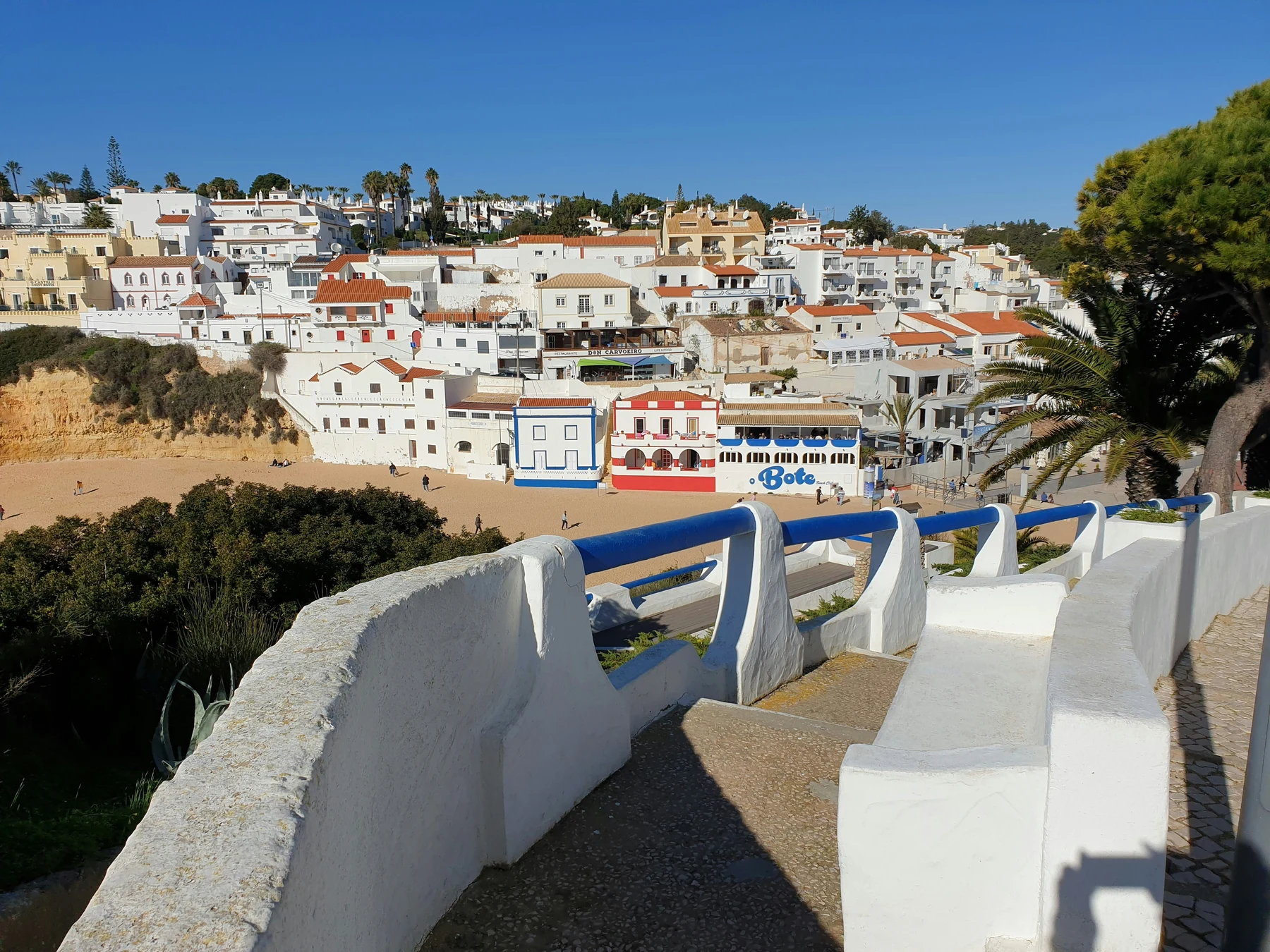
Carvoeiro is a former fishing village on the central Algarve coast, about 5km south of Lagoa. It keeps the low-rise, whitewashed character that larger resort towns have lost, and sits within walking distance of the Seven Hanging Valleys Trail, Algar Seco rock formations, and the Benagil Cave coastline. Best suited to couples and families looking for a quieter base with strong coastal access.
Why Visit Carvoeiro
Carvoeiro feels like the Algarve before everything got bigger. The town spills down a narrow valley to a horseshoe cove, white houses stacked on golden limestone cliffs, fishing boats still pulled up on the sand alongside the tourist kayaks. It has grown into a resort, no question, but the buildings stayed low, the streets stayed narrow, and nobody built a high-rise. A sizable British community has settled here over the decades, which means the restaurant scene caters to international palates without losing its Portuguese core.
The real draw is the coastline. Carvoeiro sits at the western end of the most photographed stretch of coast in the Algarve, with the Benagil Cave, Praia da Marinha, and the Seven Hanging Valleys Trail all reachable from here. You can walk from the town beach to the Algar Seco rock formations in 15 minutes, reach the Seven Hanging Valleys trailhead in 25, or drive to Benagil in under 10. Most visitors to these landmarks base themselves in Albufeira or Lagos and drive over. Staying in Carvoeiro puts you at the doorstep.
It is not the right town for everyone. Nightlife is minimal. The beach is small and gets crowded in high summer. The restaurant scene is good but not deep. If you want bars open past midnight and a wide strip of sand, Albufeira or Lagos will suit you better.
Best Things to Do in Carvoeiro
Walk the Boardwalk to Algar Seco
The Calçadão de Carvoeiro runs about 600 metres along the clifftops from the Forte de Nossa Senhora da Encarnação to Algar Seco. It is flat, railed, and accessible for pushchairs and wheelchairs. The views alone justify the 20 minutes it takes, but the destination is the real payoff: Algar Seco is a landscape of eroded limestone that looks, as several guides have noted, a bit lunar. Tidal pools, natural arches, and the A Boneca cave with its two rock windows opening to the ocean. Steps carved into the rock lead down to the formations. Worth arriving before 9am in summer if you want the place to yourself.
Hike the Seven Hanging Valleys Trail
The most popular coastal walk in the Algarve runs 5.7km between Praia do Vale de Centeanes and Praia da Marinha, passing Alfanzina Lighthouse, Praia do Carvalho (accessed via a tunnel carved through the cliff), the Benagil Cave sinkhole from above, and the double sea arch at Marinha beach. Rated moderate. Allow 2.5 to 3 hours one way. The western trailhead at Vale de Centeanes is a 25-minute walk from Carvoeiro, or about 5 minutes by car. Parking at the Marinha end fills by 9:30 to 10am in peak season.
One practical note: the trail is linear, not a loop. Most people walk one way and get a Bolt or taxi back to their car. Starting from Carvoeiro or Vale de Centeanes and finishing at Marinha puts the best views in front of you.
Take a Boat Trip to the Caves
Boats depart from Praia do Carvoeiro and from Vale de Centeanes, visiting the Benagil Cave, various grottoes, and sometimes reaching as far as Marinha. Trips run 1.5 to 2 hours. The cave itself is only accessible from the sea, and recent restrictions mean you can no longer disembark on the small beach inside. You see it from the water. Kayak and SUP trips also reach the cave and get closer to the smaller formations.
Book in advance during summer. Sea conditions cancel trips regularly, particularly in winter and spring.
Explore Algar Seco Up Close
The rock formations at the far end of the boardwalk deserve more than a passing look. Stone steps and pathways wind through the limestone, passing tidal pools full of small crabs and anemones (bring water shoes). The A Boneca cave is the centrepiece, but there are smaller openings and natural windows scattered around the site. The A Boneca bar sits just above, wedged between the rocks, serving drinks and light food from roughly April through October. Good sunset spot. Probably the best in Carvoeiro.
Day Trip to Silves
The old Moorish capital of the Algarve is 25 minutes inland by car. The red sandstone castle, the Gothic cathedral, and the small archaeological museum are the main stops. Silves is a quieter, more Portuguese town than anything on the coast, and worth combining with lunch. The drive takes you through rolling hills planted with oranges and carob trees, a landscape most coast-bound visitors never see.
Best Beaches Near Carvoeiro
Praia do Carvoeiro is the town beach, a compact cove framed by cliffs and backed by the village itself. Calm water on most days. Lifeguards June through September. It works well for a quick swim and a morning on the sand, but the narrow shoreline crowds fast in July and August.
Praia da Marinha is roughly 7km east and rated among the finest beaches in Europe. The double sea arch is the signature image, and the snorkelling along the base of the cliffs is good when conditions are calm. Parking is limited and the lot fills early in summer.
Praia de Benagil is small, often crowded because of the cave, and not ideal for a full beach day. Its value is as a launch point for kayak and boat trips. The beach bar above serves decent grilled fish.
Praia do Carvalho is hidden behind a cliff and accessed through a hand-carved tunnel staircase. Tiny. Very little shade. Spectacular. It sits roughly halfway along the Seven Hanging Valleys Trail, so most people visit it while hiking.
Praia do Paraíso is a 5-minute walk west of the town beach, down a steep staircase of about 115 steps. Almost empty compared to the main beach, it partly disappears at high tide. No facilities, no lifeguard. Good option for escaping the crowd if you are reasonably mobile.
Where to Eat in Carvoeiro
The restaurant strip runs along the Estrada do Farol, the road climbing from the beach toward the east. Most places cluster within a 10-minute walk of the sand. The quality is above average for an Algarve resort town, partly because Carvoeiro’s size keeps out the worst of the mass-tourism operations.
Bon Bon, in the hills of Sesmarias about 5 minutes’ drive from the centre, is the standout. A Michelin star since 2015, now under Chef José Lopes, with tasting menus rooted in Algarvian produce and occasional nods to Indian spice traditions. The lunch menu offers a more approachable entry point. Not cheap, obviously. But the cooking justifies the price in a way that plenty of Michelin restaurants along this coast do not.
For a different kind of evening, Jota Lita on Estrada do Farol does straightforward traditional Portuguese cooking in a family-run setting. The grilled fish is reliable, the atmosphere warm, the portions leave no room for complaint. Seating is limited, so book ahead in high season.
O Pescador above Benagil beach (about 10 minutes’ drive) is worth the trip for the panoramic terrace and fresh-off-the-boat seafood. Arrive before the lunch rush or accept a wait. Bela Rosa, in the centre, is the reliable budget option: honest food, decent prices, open when others close for the season. Nothing remarkable, but consistently solid.
Skip the cluster of tourist-facing restaurants immediately around the beach square unless you are happy paying a premium for the view. The better cooking is a 5-minute walk uphill.
Where to Stay in Carvoeiro
Most accommodation is villas and apartments spread through the hills surrounding the town. This is the dominant format and it works well, particularly for families. A car becomes more or less necessary if you are staying outside the centre.
The Tivoli Carvoeiro is the main large hotel, positioned on the cliffs east of town. The views are excellent and the pool complex is a genuine draw, but it sits about a 15-minute walk from the town centre and restaurants. Good for a resort experience, less ideal if you want to walk to dinner nightly. Monte Santo Resort, set back in the hills, offers apartment-style accommodation with gardens and pools in a quieter setting.
Budget options are limited compared to Lagos or Albufeira. Guesthouses like Castelo Guest House near the beach fill quickly in summer. For the best rates, book early. Prices across Carvoeiro jump significantly from late June through August.
One pattern worth knowing: accommodation close enough to walk to the beach and restaurants commands a premium. Properties 5 to 10 minutes’ drive up in the hills are often half the price, with better pools and more space. The trade-off is needing a car for every meal out.
How to Get to Carvoeiro
From Faro Airport: The drive is about 60km and takes roughly 45 minutes via the A22 motorway (tolled). The toll-free alternative via the N125 adds 15 to 20 minutes. Private transfers and taxis are available from the airport. Bolt and Uber are also available.
By bus: There is no direct service. Take the Vamus bus from Faro to the Lagoa bus terminal (about 1 hour 10 minutes), then transfer to line 107, which runs between Lagoa and Carvoeiro roughly six times daily, less on weekends. Total journey time is around 2 hours including the wait. The nearest train station, Estômbar-Lagoa, is on the Lagos line but sits about 8km from Carvoeiro with no convenient onward bus, so you would need a taxi from there.
From Lisbon: About 280km, roughly 2.5 to 3 hours by car via the A2. Long-distance coaches run from Lisbon to Lagoa, from where you can take a local bus or taxi to Carvoeiro.
From other Algarve towns: Portimão is 15 to 20 minutes’ drive west. Albufeira is about 25 to 30 minutes east. Lagos is 40 to 45 minutes west. All are connected by the N125 or A22.
Local Tips
The town empties between October and April. A handful of restaurants stay open through winter, but many close entirely. If you are visiting outside summer, check ahead before assuming anywhere will be serving. The upside of the off-season is dramatic: the boardwalk will be deserted, hiking conditions are ideal, and accommodation drops to a fraction of summer prices. Carvoeiro in May or September is arguably a better destination than Carvoeiro in August.
Parking deserves its own warning. In July and August, the centre becomes a slow crawl of cars looking for spaces that do not exist. If your accommodation does not include parking, you will spend real time circling. Bolt works well here and costs very little for short trips. Consider parking at Algar Seco (the larger lot) and walking into town if you must drive.
The Estrada do Farol doubles as the main restaurant strip and the main road out of town toward the beaches. At meal times in summer, the pedestrian traffic and the car traffic compete for the same narrow space. It is not dangerous, but it is chaotic. Walk it rather than drive it if you are heading to dinner.
There is a small supermarket in the centre for basics, and a larger Intermarché in Lagoa (5 minutes’ drive) for a proper shop. Lagoa hosts a weekly morning market that is worth the detour if you are self-catering, with local produce, cheese, and dried fruit at good prices.
The Estrada do Farol is where most of the restaurants and life are concentrated, running uphill from the beach. The beach itself is small and the waterline narrow, so on busy summer days the sand feels more crowded than the actual numbers justify. Arrive before 10am for a decent spot, or skip town beach entirely and drive 5 minutes to Vale de Centeanes.