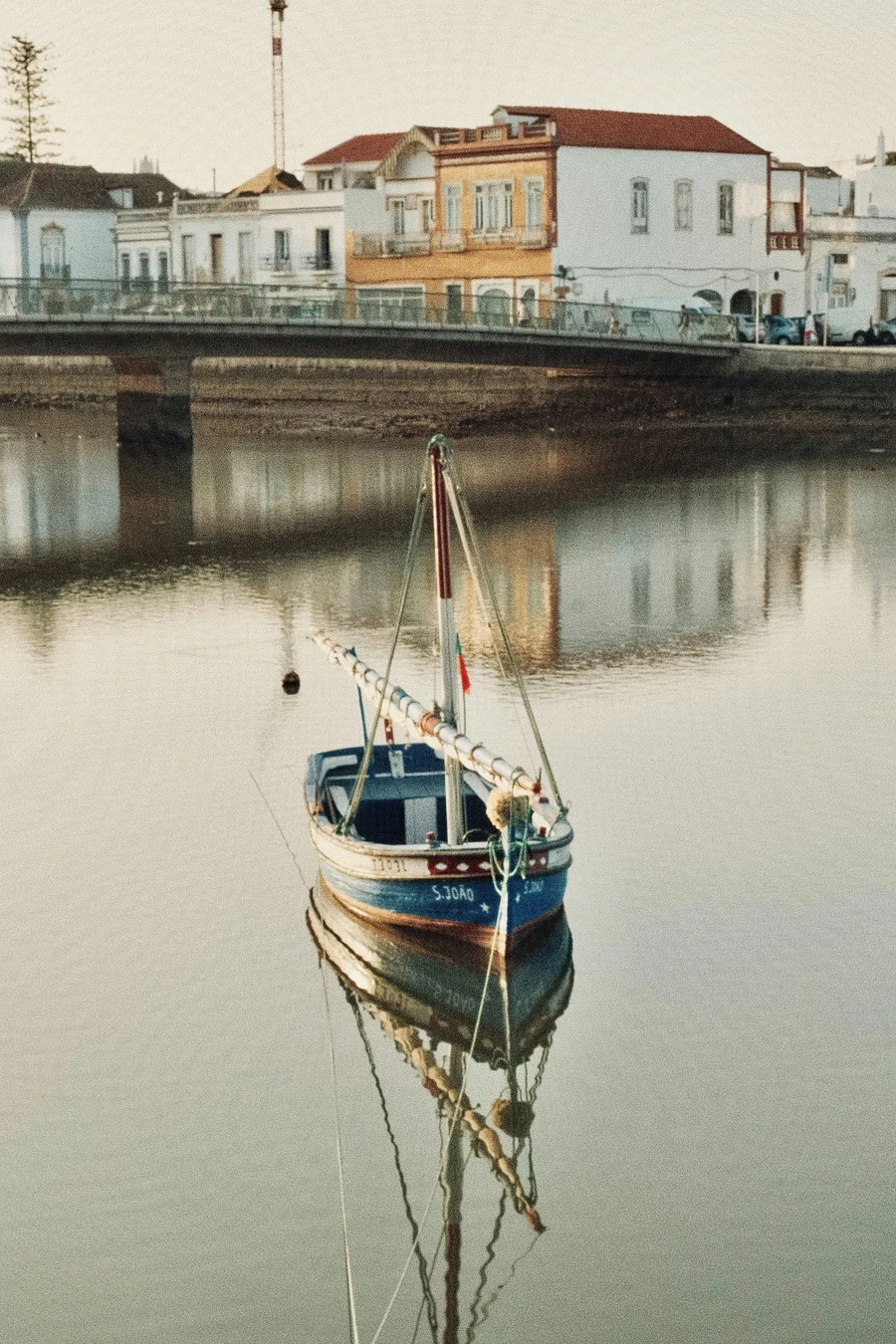
Tavira is a historic riverside town in the eastern Algarve, 35km east of Faro. It is the best-preserved town in the region, with Moorish castle ruins, over 20 churches, and ferry access to the sandbar beaches of the Ria Formosa Natural Park. Best suited to couples, culture-focused travellers, and anyone wanting a quieter, more Portuguese alternative to the western Algarve resorts.
Why Visit Tavira
Tavira is the town other Algarve towns used to be before the resort hotels arrived. It sits on both banks of the Gilão River, about 35km east of Faro, and it has held onto its Portuguese character more stubbornly than anywhere else on the southern coast. The old town is a tight web of cobbled streets, whitewashed houses with pyramid-shaped terracotta rooftops (a style unique to this part of the Algarve), and more churches than any town this size should reasonably have. Over 20 at last count.
The appeal is specific. Tavira is not the place for water parks, bar crawls, or mega-resorts. It is the place for long meals by the river, morning walks through the fish market, afternoons on near-empty island beaches, and evenings where the biggest decision is whether to eat octopus or sea bass. The town attracts a noticeably older and more European crowd than the western Algarve, lots of Northern European couples who have been coming for years and are fiercely protective of its lack of development. Spain is 30 minutes away by car, and day trips to Seville are common, which gives Tavira a slightly cross-border feel that Lagos and Albufeira don’t have.
Best Things to Do in Tavira
Walk the Castle Ramparts
The Castelo de Tavira sits on the hill above the old town, a short climb from Praça da República. The castle dates to the Moorish period and was rebuilt in the 13th century under King Dinis, though the 1755 earthquake reduced much of it to ruin. The interior is essentially a garden now, shaded and quiet, with Mediterranean plants and benches. The ramparts are the reason to come. The view spans the full terracotta rooftop panorama of the old town, the river, the salt flats, and the Ria Formosa lagoon stretching south to the barrier islands. Free entry.
Igreja da Misericórdia
The finest Renaissance church in the Algarve, built in 1541. Most of the interior decoration dates from the 1700s: gilded retables, blue-and-white azulejo tile panels lining the walls. The bell tower is open and gives a different angle on the town than the castle. The church sits right next to the Camera Obscura, so the two pair naturally. Allow 20-30 minutes. Small admission fee; check opening hours locally.
Camera Obscura in the Water Tower
Tavira’s old water tower, built in 1931 and around 30 metres above sea level, has been converted into a camera obscura. Inside a darkened room at the top, a lens and mirror system projects a live, real-time image of the town below onto a concave white screen. A guide narrates what you’re seeing, pointing out landmarks and (occasionally) unsuspecting pedestrians. Sessions run every 30 minutes, last about 20 minutes, and accommodate up to 15 people. There’s a lift for those who’d rather not take the stairs. Small admission fee. Not operational in winter or bad weather, as the device needs clear light.
Worth it for the novelty alone. There are only a handful of camera obscuras open to the public in Europe.
Ferry to Ilha de Tavira
The main beach experience near Tavira involves a short boat crossing. Ferries depart year-round from the Quatro Águas pier, about 1.5km southeast of the centre (walkable, or take a taxi). The crossing takes only a few minutes. On the island, the beach extends for kilometres: wide, sandy, backed by dunes. The western end near the ferry landing has beach bars, sun loungers, and a restaurant. Walk east and the crowds thin rapidly. The far eastern end is a legal nudist area. Water on this stretch of coast is typically warmer than the western Algarve, reaching around 22-23°C in August.
Praia do Barril and the Anchor Cemetery
Accessible from the Pedras d’El Rei resort area (about 4km west of Tavira), a small-gauge railway crosses the Ria Formosa marshes to reach Barril beach. The train ride itself is part of the experience, though you can also walk the 2km path beside the tracks. At the entrance to the beach sits the Cemitério das Âncoras: rows of rusting anchors planted in the sand, a memorial to the bluefin tuna fishing industry that shut down in the 1960s and 1970s. The beach beyond is wide and clean. It gets busy in August but is noticeably quieter than Ilha de Tavira.
Octopus in Santa Luzia
Santa Luzia is a small fishing village 3km west of Tavira along the waterfront. It calls itself the capital do polvo, the octopus capital of Portugal, and the waterfront restaurants back up the claim. The octopus here comes straight from the local boats, cooked grilled, in cataplana, or as arroz de polvo (octopus rice). Casa do Polvo is the most famous option. Budget 40-50 minutes for the food to arrive once ordered, which is the cost of getting octopus cooked properly rather than reheated. The walk or cycle from Tavira along the waterfront is flat and pleasant.
The Old Town and Roman Bridge
No single attraction justifies a bullet point, but the old town as a whole does. Enter through the Porta de Dom Manuel, a stone gateway from 1520 when Tavira gained city status. The streets behind it are narrow and cobbled, the houses have those distinctive pyramid rooftops and hand-shaped door knockers (a tradition that may trace back to the Phoenicians, who settled here around the 8th century BC). The Ponte Antiga over the Gilão River is called the Roman Bridge, though the current structure is likely medieval. It is the best spot in town for photographs, particularly at dusk when the buildings catch the last light. The Palácio da Galeria, a 16th-century palace, hosts rotating art exhibitions and is worth checking whatever happens to be showing.
Best Beaches Near Tavira
Praia da Ilha de Tavira is the main beach, reached by ferry from Quatro Águas. Long, wide, and with facilities at the western end near the landing. Best for anyone wanting a full beach day with the option of restaurant lunches without leaving the sand.
Praia do Barril is quieter and more distinctive. The miniature train crossing, the Anchor Cemetery at the entrance, and the slightly less crowded sand make it the better choice for a more atmospheric half-day. Families with young children tend to prefer Barril for the calmer vibe.
Praia de Cabanas, accessible from the village of Cabanas de Tavira (10 minutes east by car, or reachable by bus), is a long sandbar beach with warm, shallow water. Less infrastructure than Ilha de Tavira but also fewer people. Good for long walks.
Praia da Terra Estreita sits between Barril and Ilha de Tavira and is the least visited of the group. No facilities to speak of. If your definition of a good beach involves seeing almost nobody else, this is the one.
Where to Eat in Tavira
Tavira’s food scene has improved sharply in recent years. The arrival of A Ver Tavira’s Michelin star in 2021 raised the town’s profile, and younger chefs have followed. The result is a town where you can eat extraordinarily well across a range of budgets, which was not the case a decade ago.
A Ver Tavira is the special occasion restaurant. Perched beside the castle walls, with a terrace that overlooks the entire town, it runs tasting menus built around local ingredients. Chef Luís Brito and sommelier Cláudia Abrantes run it as a husband-and-wife operation. Fine-dining pricing. Book well in advance. Mesa Farta, opened in 2024 and already Michelin-recommended, is the newer contender. Chef João Viegas trained internationally (El Celler de Can Roca, Viajante in London) before returning to Tavira, and the menu reflects that range while staying rooted in Portuguese ingredients. More accessible pricing than A Ver Tavira, and the atmosphere is less formal.
For everyday eating, Ponto de Encontro is the kind of place where locals go when they don’t feel like cooking. No pretension, honest portions, and grilled fish that was swimming that morning. Prices are low. O Tonel, on a quieter side street, is more atmospheric and slightly more refined, good for a date night without the Michelin price tag. The duck and the clams are reliable choices.
The riverfront restaurants along Rua José Pires Padinha are tempting in the evening light but uneven in quality. Some are genuine, others coast on the view. A useful rule: if the menu is displayed on a large illuminated board in four languages, keep walking.
The municipal market (Mercado Municipal) is open Monday to Saturday mornings for those self-catering. The fish section alone is worth the visit even if you’re not buying.
Where to Stay in Tavira
The best option in the centre is the Pousada Convento de Tavira, a converted convent that operates as a four-star hotel. The building itself is half the experience, with cloisters, a pool in the courtyard, and rooms that retain some of the original architecture. It puts you within two minutes’ walk of the castle and the old town. Prices reflect the location and the heritage setting.
For a more contemporary option, the Ozadi Tavira Hotel sits on the EN125 outside town, next to Benamor golf course. Retro-modern design, two restaurants, a pool, and 77 spacious rooms. The trade-off is location: you’ll need the free shuttle or a car to reach the centre. It works well for families and anyone who values pool time and space over proximity to the old town. Mid-range pricing in low season, significantly more in July-August.
Budget travellers have Hi Tavira, the youth hostel (Pousada de Juventude), which is clean and centrally located. Several guesthouses line the riverfront, with Residencial Marés being one of the more popular options for its location directly facing the Gilão. Self-catering apartments are widely available through the usual platforms and represent the best value for stays of a week or more, particularly outside the centre where parking is easier.
The key trade-off is centre versus outskirts. Staying in the old town means walking access to everything, including the ferry pier, but parking your car will be a daily frustration in summer. Staying outside town (Ozadi, or a villa rental) means needing the car for most activities but having space and quiet. For a first visit of three to four nights, the centre is worth the parking hassle.
How to Get to Tavira
From Faro airport: The drive is about 38km east, almost all of it on the A22 motorway (tolled). Allow 30-35 minutes. A pre-booked private transfer is the most convenient option; metered taxis are also available. Uber and Bolt operate in the Algarve, though availability is patchy in winter and surge pricing applies in peak summer. If you’re renting a car, the agencies are at the airport and the route to Tavira is straightforward.
By train: Tavira’s station (Porta Nova) is served by the regional Algarve line. From Faro station (not the airport, which has no rail link), trains run roughly every one to two hours and take 35-40 minutes. Make sure to board the train heading towards Vila Real de Santo António, not Lagos. The station in Tavira is a 10-minute walk from the centre. This is the recommended route from Faro if you don’t need a car.
By bus: Vamus bus 67 connects Faro bus station to Tavira in about an hour, with several departures per day on weekdays. The bus station in Tavira is central. From Lisbon, Rede Expressos runs direct coaches (approximately 4 hours, departures from Sete Rios).
From Lisbon by car: Take the A2 south to the Algarve, then the A22 east towards Tavira. About 300km, roughly 2 hours 45 minutes. Expect around €20 in tolls.
From Spain: The Spanish border at Vila Real de Santo António is 30 minutes east. The A22 connects directly to the Spanish motorway towards Huelva and Seville (about 2.5 hours from Tavira to Seville).
Local Tips
The Mercado Municipal is the pulse of daily Tavira. It opens at 7am Monday through Saturday, and the fish section is at its liveliest before 9am when restaurant owners are buying for the day. The fruit and vegetable stalls sell local produce, and you’ll find stalls with Flor de Sal (local sea salt from the salt flats just south of town) and Doce do Algarve, the decorative marzipan sweets shaped like fish and fruit that make genuine local gifts. The old Mercado da Ribeira on the waterfront, built in 1887, no longer sells produce. It was converted into a small cultural space with shops, restaurants, and occasional exhibitions.
Tavira runs on a slower schedule than the western Algarve towns. Many restaurants close between lunch and dinner (roughly 3pm to 7pm), and some close entirely on Mondays. The town is noticeably quieter from November to March, when the Camera Obscura shuts for the season and some restaurants reduce hours or close. April, May, and October are the sweet spot: warm enough to use the beaches, quiet enough to get a table without booking. The flea and antiques market (Feira de Velharias) happens on the first and fifth Saturdays of each month near the municipal market, and a farmers’ market runs on the third Saturday at Vale Formoso.
The sunset situation in Tavira is different from the western Algarve. Because the coast faces south rather than west, you don’t get the dramatic over-the-ocean sunsets that Lagos or Sagres are known for. The best evening light in Tavira falls across the old town buildings as seen from the south bank of the river, or from the castle ramparts looking north towards the Serra do Caldeirão. If you specifically want a sunset-over-the-sea moment, drive the 12km to Cacela Velha, where the clifftop position gives a wider western view across the lagoon.
The Mercado Municipal sells fresh fish and produce Monday to Saturday, 7am to 1pm. Go before 9am for the best fish selection and to see locals buying for the day's cooking. The marzipan sweets shaped like fish and fruit (Doce do Algarve) sold at the stalls make a better souvenir than anything in the tourist shops.