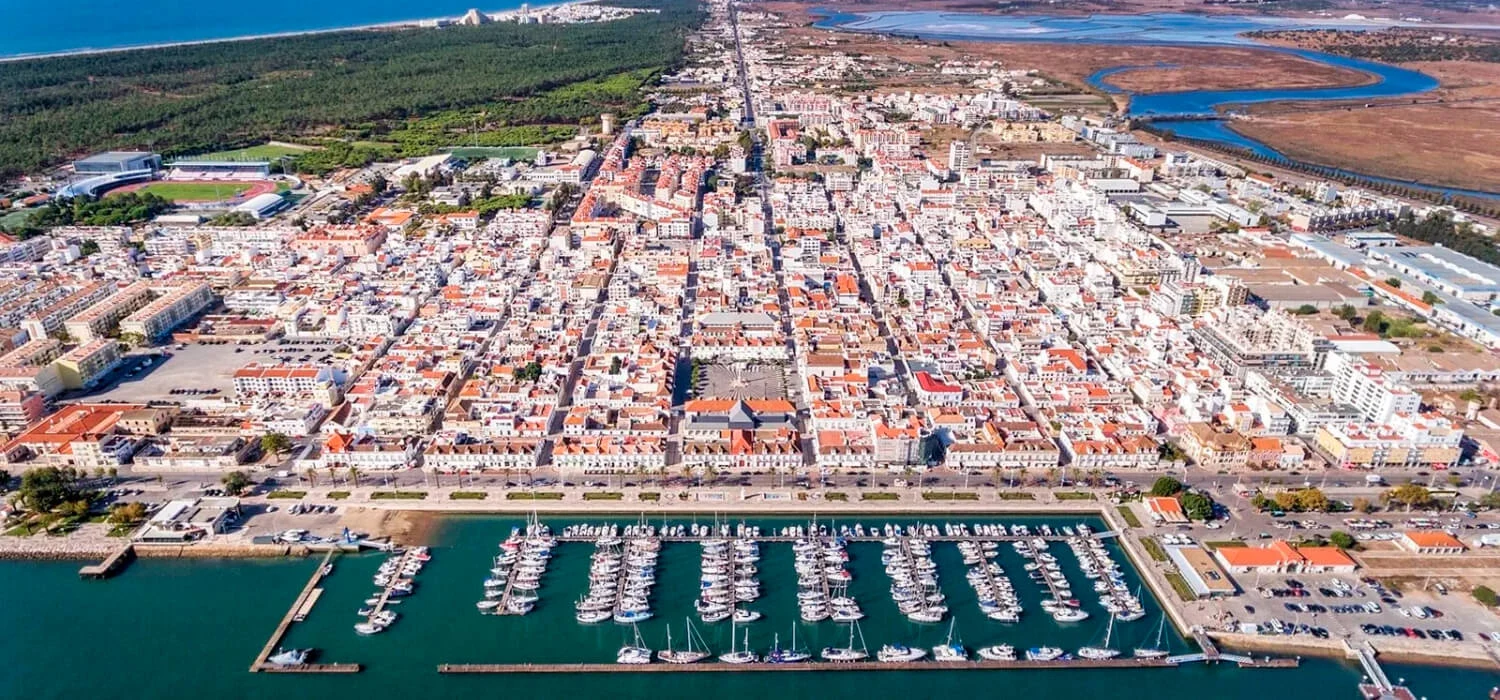
Vila Real de Santo António sits on the Guadiana River at the Algarve's eastern edge, directly across from Ayamonte in Spain. Built in the 1770s by the Marquês de Pombal in the same geometric grid used to reconstruct Lisbon after the 1755 earthquake, its formal central square and ordered streets give it a character unlike any other town in the region. A regular ferry connects it to Spain in about 15 minutes.
Why Visit Vila Real de Santo António
Most Algarve towns grew slowly over centuries, shaped by fishing and farming and the gradual accretion of buildings around a harbour or a hilltop. Vila Real de Santo António was drawn on paper first. After the 1755 earthquake, the Marquês de Pombal ordered this border town built from scratch using the same geometric grid and prefabricated construction techniques he deployed in Lisbon’s Baixa district. The whole thing went up in about two years, completed in 1776. That planned origin is still readable in every street: straight lines, uniform façades, a formal central square with an obelisk. Nothing else in the Algarve looks or feels like this.
The town sits on the Guadiana River, which forms the border with Spain. Ayamonte is visible across the water, close enough that Spanish voices carry on a still evening. That proximity gives VRSA a cross-border character that is genuinely unusual. People ferry across for lunch, for shopping, for no particular reason other than the crossing itself. It is a town defined more by its river than by the sea, more by its geometric bones than by any single attraction. Not a place for a week-long stay, but a rewarding half-day or full day for anyone interested in history, architecture, or simply seeing a corner of the Algarve that feels like nowhere else.
Best Things to Do in Vila Real de Santo António
Praça Marquês de Pombal
The square is the town’s centrepiece and its clearest expression of Pombaline urban planning. An obelisk stands at the centre, commissioned by Pombal himself to honour King José I. Orange trees line the perimeter. Whitewashed buildings with uniform rooflines frame all four sides. The black cobblestones in the paving came from Madeira, the white ones from Spain. On a weekday morning the square is quiet enough to appreciate the geometry. Café tables fill it later in the day.
Ferry to Ayamonte
The river crossing is the thing most visitors remember. The ferry takes about 15 minutes, running regularly throughout the day (reduced on Sundays). Ayamonte on the Spanish side has its own character: tapas bars, a hilltop church, cobbled streets that feel distinctly Andalusian. The crossing is cheap, the views from mid-river are good, and the novelty of changing countries by boat is hard to overstate. Remember that Spain is one hour ahead of Portugal. The Guadiana International Bridge upstream made the ferry functionally redundant in 1991, but it persists as a tourist draw and a convenience for pedestrians and cyclists (who are not permitted on the bridge).
Galeria Manuel Cabanas
On Praça Marquês de Pombal, this small museum is easy to overlook and worth not overlooking. It holds Portugal’s largest collection of wood engravings, the life’s work of Manuel Cabanas, born in nearby Vila Nova de Cacela in 1902. His woodcuts depict everyday Portuguese life with extraordinary detail. Downstairs, a collection of more than 200 lithographic stones used to print labels for the local sardine and tuna canneries connects the art to the town’s industrial past. Brief visit. High reward-to-time ratio.
Guadiana Riverfront and Marina
The Avenida da República runs along the river, lined with two-storey Pombaline buildings that were deliberately designed as a show of Portuguese confidence facing Spain. The marina sits at the northern end, and walking south from here takes you past cafés, the ferry terminal, and eventually to the mouth of the river where the Guadiana meets the Atlantic. The light changes along this walk, particularly in the late afternoon. The river is wide and slow here, and on clear days you can see far upstream.
Mata Nacional das Dunas
South of the town centre, a pine forest planted in the 19th century to stabilise coastal dunes now serves as a green buffer between the town and the beach. Walking or cycling trails run through it, and the forest is home to the Mediterranean chameleon, a protected species that you are unlikely to see unless you move very slowly and look very carefully. The forest connects to Praia de Santo António, making a walk from the town centre to the beach a genuine experience rather than a quick transfer.
Centro Cultural António Aleixo
Named after the town’s most celebrated figure, the popular poet António Aleixo (1899-1949), this cultural centre occupies the old market building on Rua Teófilo Braga. It hosts rotating exhibitions and occasional performances. The building’s conversion from military barracks to vegetable market to cultural space tracks the town’s own evolution.
Vila Real de Santo António Lighthouse
Visible from almost anywhere in town, the 40-metre lighthouse was built in 1923 on an inland site because the sandy coastline was too unstable for construction near the shore. It marks the transition between the town and the dunes. The lighthouse is currently closed for renovation works; check locally before planning a visit.
Best Beaches Near Vila Real de Santo António
Vila Real de Santo António is not a beach town in the way that Lagos or Albufeira are, but it sits at the eastern end of a 14km stretch of sand that runs all the way to Cacela Velha.
Praia de Santo António is the closest beach, reached through the Mata Nacional pine forest on foot, by bike, or via a summer tourist train. It sits at the mouth of the Guadiana and is one of the quieter beaches in the Algarve, even in peak season. The water here tends to be a degree or two warmer than the south coast average, reaching around 23-24°C in August, thanks to the sheltered eastern position and Mediterranean influence. No cliffs, no coves, just wide flat sand backed by dunes.
Praia de Monte Gordo, about 3km west, is the area’s main beach. Wide, flat, backed by a promenade with restaurants and bars, and lined with high-rise hotels behind. It draws Spanish day-trippers from across the border and Portuguese families in summer. The water is warm and calm by Algarve standards. Not dramatic, but functional and well-serviced.
For something with more character, Praia de Cacela Velha is about 20 minutes’ drive west. The wade across the lagoon and the views back to the clifftop hamlet above make it a different experience entirely.
Where to Eat in Vila Real de Santo António
The restaurant scene here is honest rather than exciting. Seafood dominates, as it should in a former canning and fishing town, and prices sit noticeably below what you would pay in the central Algarve for comparable quality.
The Avenida da República along the riverfront has the highest concentration of restaurants, most with terraces facing Spain. Caves do Guadiana is a solid pick for grilled fish with river views. di.Vino, also on the Avenida, works better as a wine-and-small-plates stop than a full dinner destination. The oysters are good, the atmosphere is more intimate than the terrace restaurants either side of it.
Off the main drag, Restaurante Jaime on Rua Dr. Sousa Martins is where locals tend to point visitors. The Iberian pork secretos and the fresh grilled fish both justify the recommendation. It fills up at dinner. Coração de Cidade has a reputation as the most consistent restaurant in town, the kind of place where nothing is spectacular but nothing disappoints.
One broader tip: the proximity to Spain means a few restaurants lean into Iberian fusion, and Spanish visitors crossing for dinner bring their own dining rhythm (later starts, longer meals). Eating here after 9pm feels more natural than in many Algarve towns.
Where to Stay in Vila Real de Santo António
The accommodation landscape here is thinner than in the central Algarve, which is part of the appeal for certain visitors.
The standout is the Grand House, a Relais & Châteaux property on Avenida da República. A five-star boutique hotel in a restored belle-époque building with 30 rooms, river views, and an art deco sensibility that suits the town’s Pombaline formality. It is a genuine luxury property in a place where you would not expect to find one, and the contrast between its polished interior and the quiet streets outside is part of the experience. A splurge, but a memorable one.
For mid-range and budget options, the town has guesthouses and rental apartments scattered through the centre. The Pombaline grid makes everything walkable, so location within the town matters less than in sprawling resort areas. Avoid accidentally booking in Monte Gordo if you want VRSA’s character: the two are close geographically but completely different in atmosphere. Monte Gordo is high-rises and package tourism. VRSA is quiet streets and orange trees.
Prices drop significantly outside July and August. The eastern Algarve, broadly, offers better value than the central coast.
How to Get to Vila Real de Santo António
Vila Real de Santo António is about 55 minutes from Faro Airport via the A22 motorway, which is tolled. The N125 is the toll-free alternative and takes longer, but passes through Tavira and the turnoff for Cacela Velha, making it worth considering if you plan to stop along the way.
VRSA is the eastern terminus of the Algarve railway line. Trains run from Faro regularly, with a journey time of roughly an hour and ten minutes. The station is walkable from the centre but sits in an unattractive area north of town. Do not let the surroundings of the station set your expectations for the town itself.
From Spain, the Guadiana International Bridge carries the A22/A49 motorway, or the ferry from Ayamonte is the more enjoyable option for foot passengers and cyclists. The bridge is the only option if you are driving from Seville (about two hours away), and the tolls are payable by electronic tag.
Parking in VRSA is straightforward. Free street parking is available along the riverfront and near the marina, and even in summer the town does not generate the parking pressure that plagues towns further west.
Local Tips
The time zone difference catches everyone once. Spain is one hour ahead of Portugal, and the ferry crossing is short enough that you can forget you have changed time zones. If you book a restaurant in Ayamonte for 1pm Spanish time, you need to be on the ferry by noon Portuguese time at the latest. Phones usually switch automatically, but watches do not.
Saturday morning is the best time to visit if you want to see the town at its most alive. The weekly market adds energy to the streets, and the cafés around Praça Marquês de Pombal fill up earlier than usual. Weekday afternoons can feel genuinely quiet, especially outside summer.
Castro Marim is only about 4km north and makes a natural pairing with VRSA. The castle there has panoramic views, and the Castro Marim and Vila Real de Santo António Marsh Natural Reserve (Portugal’s first nature reserve, established in 1975) is notable for birdwatching: flamingos, storks, spoonbills, and a range of migratory waders depending on the season. If you are already in VRSA, the detour is minimal and the contrast in landscape is striking. The marshes and the geometric town feel like they belong to different regions, not neighbouring parishes.
Air temperatures in the eastern Algarve mirror the rest of the coast: highs around 29-30°C in July and August, dropping to a comfortable 22-23°C in May and September. The town is not particularly windy, unlike the western coast, which makes evenings on the riverfront pleasant well into October.
Spain is one hour ahead of Portugal. If you take the ferry to Ayamonte, adjust for the time difference or you will be either very early or very late for everything. The ferry terminal in VRSA is behind the Polícia building near the marina, not immediately obvious on first visit.