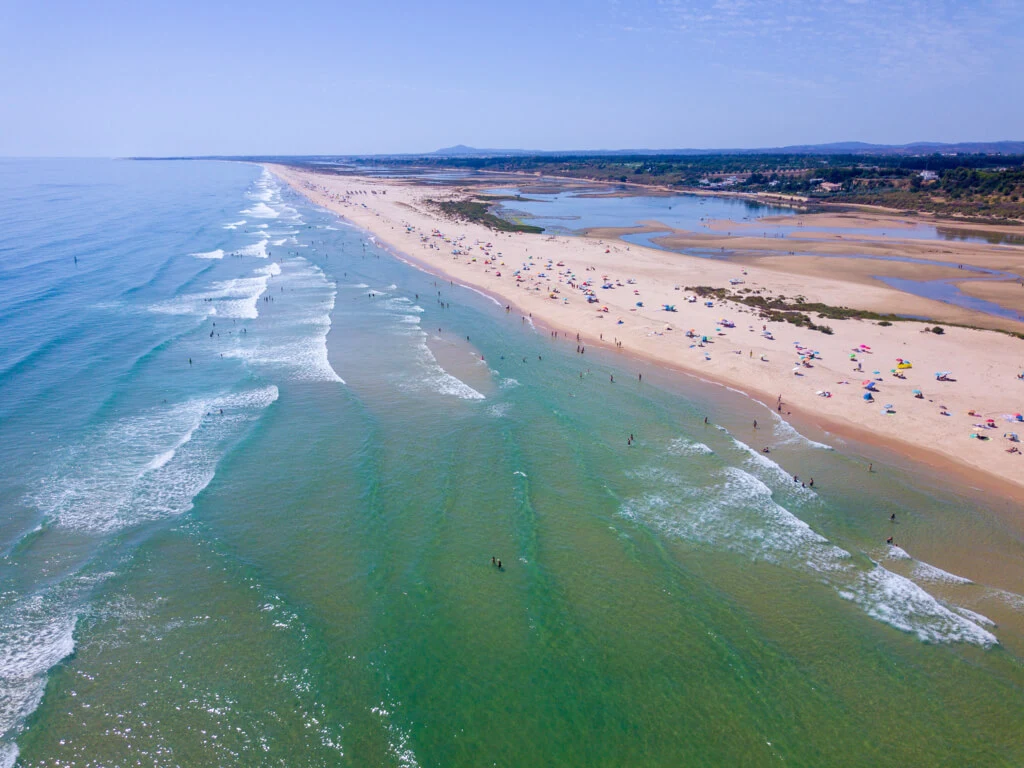
Cacela Velha is a clifftop hamlet in the eastern Algarve, perched above the Ria Formosa lagoon in the municipality of Vila Real de Santo António. A handful of whitewashed houses, a 16th-century church, and a fortress wall frame one of the best viewpoints in the region, with a barrier island beach accessible by boat or by wading across the lagoon at low tide.
Why Visit Cacela Velha
Cacela Velha is barely a village. A church, a fortress wall, a cemetery, a handful of whitewashed houses, and two restaurants arranged around a clifftop overlooking the Ria Formosa lagoon. You can walk the entire place in fifteen minutes and still have seen every street. On paper, it sounds like something you’d drive through without stopping.
In practice, it’s one of the most memorable spots in the Algarve. The view from behind the church, where the land drops sharply to the lagoon and the barrier island stretches towards the Atlantic, has a quality that photographs consistently fail to capture. The water, the sand, and the light shift with every tide. Poets have been writing about Cacela Velha for over a thousand years, which either tells you something about the place or about poets. The Islamic poet Ibn Darraj al-Qastalli was born here in 958; the streets are now named after him and the Portuguese writers who followed. This isn’t a town with a list of attractions to tick off. It’s a place to sit on the bench by the fortress wall, eat oysters from the lagoon below, and let an hour disappear.
Best Things to Do in Cacela Velha
The Ria Formosa Viewpoint
The view from behind the Igreja Matriz is the reason most people come, and it earns the visit on its own. Cacela Velha sits at the eastern edge of the Ria Formosa Natural Park, and the clifftop position gives a panorama across the lagoon, the shifting sandbars, and the long barrier island beach below. The landscape changes with the tides. At low water, the sand extends and the channels narrow; a few hours later, the whole scene rearranges. There’s a bench. It’s the right place to use it.
Igreja Matriz de Cacela Velha
The church was built in 1538 on the ruins of a 13th-century church, which itself likely replaced a mosque from the Moorish period. The 1755 earthquake damaged it severely, and what stands today is the late 18th-century reconstruction. The facade is plain white, almost severe, but the Renaissance portal at the entrance has a detail worth noticing: small carved heads of Saints Peter and Paul flanking the doorway. Inside, the church houses an 18th-century statue of Nossa Senhora da Assunção, to whom it is dedicated. In August, the church doubles as a concert venue for Clássica em Cacela, an annual series of classical music performances that have been running for over a decade.
Fortaleza de Cacela
The fortress at the southern edge of the village has been a defensive site since the Moorish period. Archaeological excavations in 2007 confirmed Cacela Velha as the medina of Qast’alla Daraj, an Islamic settlement dating to the 10th century. The Moors fortified this clifftop in 713; the Christian knights of the Order of Santiago took it during the Reconquista around 1240. What you see today is largely 16th-century construction, rebuilt after the earthquake. The fortress itself is not always open to enter, but the Largo da Fortaleza (the square beside it) is one of the village’s two gathering points, and the views from the wall are part of the same panorama that makes the church viewpoint so good.
Walking the Village Streets
Fifteen minutes is enough to cover every cobbled street. That’s not a criticism. The whitewashed houses with their blue and yellow trim, the ornate Algarvian chimneys on the rooftops, the bougainvillea spilling over low walls: the details are the point. The street signs display names and excerpts from poets who wrote about Cacela Velha. You’ll also find a cisterna (the old water storage system) and, charmingly, an insect hotel: a small ecological installation encouraging pollinating insects. The village has been selected by Portugal’s regional development commission as one of ten Algarve villages for heritage renovation, which helps explain why it looks so well-maintained for somewhere so tiny.
The Walk Down to Praia de Cacela Velha
From the village, follow signs to Sítio da Fábrica on the western side. A steep but graded path leads down from the clifftop to the edge of the lagoon channel. At low or mid tide, you wade across (knee-deep, warm, sandy bottom) to reach the barrier island beach on the other side. The name Fábrica comes from a ceramic factory that operated here from the 1890s to 1940. The crossing, with the clifftop silhouette of the village above you and the open beach ahead, is one of those moments that stays. Small boats also make the crossing when the water is too deep to walk.
Best Beaches Near Cacela Velha
Praia de Cacela Velha is the obvious one: a long barrier island beach reached by the lagoon crossing described above. The water on the lagoon side is calm and warm (typically 1-2°C warmer than the south coast average, reaching 23-25°C in August), and the beach empties out quickly if you walk in either direction. Facilities are minimal: a seasonal beach bar and not much else.
Praia de Cabanas is the next barrier island beach to the west, accessed by boat taxi from Cabanas de Tavira. Similar character to Cacela’s beach but with slightly more infrastructure and an easier crossing. About 8km by road from Cacela Velha.
Praia da Ilha de Tavira offers a different island beach experience with more facilities, including several restaurants on the island itself. The ferry runs from Tavira’s waterfront, about 11km west of Cacela Velha.
Manta Rota beach, to the east, is the nearest mainland beach: wide, flat, warm water, and directly on the road rather than requiring a boat crossing. It lacks the drama of the island beaches but is straightforward when you want sand without logistics.
Where to Eat in Cacela Velha
The dining scene in Cacela Velha is three restaurants. For a place this small, that’s generous, and one of them is genuinely excellent.
Casa da Igreja occupies the church square and serves petiscos (small plates) of seafood pulled from the Ria Formosa below. The oysters are the draw. Plump, briny, served on steel trays at communal wooden tables with a view that most waterfront restaurants in the Algarve would trade their entire fit-out for. Clams in garlic and white wine, grilled chouriço, local goat’s cheese, and bread from the oven complete the menu. There are no reservations, no courses in the conventional sense, and the queue in summer is real. The restaurant opens in the late afternoon; be there at opening or be prepared to wait. Worth every minute of the wait, but that’s easy to say in retrospect.
Casa Velha sits on the Rua Sophia de Mello Breyner Andresen (the village’s main street, insofar as a place this small has one). More of a proper restaurant than Casa da Igreja, with a covered terrace, a menu that extends beyond petiscos to grilled fish and seafood rice, and table service. The bacalhau à lagareiro has its regulars. It absorbs the overflow from Casa da Igreja, which sounds like faint praise but isn’t: it’s a good restaurant that happens to be next to an exceptional one.
For a wider selection, Vila Nova de Cacela is 2km away and Manta Rota 5km. Both have more options at lower prices than you’ll find in the village itself.
Where to Stay in Cacela Velha
Cacela Velha itself has almost no accommodation. A handful of rental villas exist within or near the historic walls, and the experience of staying overnight (when the day-trippers leave and the village goes quiet) is worth the effort of finding one. But options are extremely limited.
The surrounding area fills the gap. Vila Nova de Cacela, Manta Rota, and the stretch of coast between Cacela and Tavira all have hotels, guesthouses, and rental properties at prices noticeably lower than the central and western Algarve. Several golf resorts sit in the countryside north of the village. Staying in Tavira (11km west) gives you a proper town with restaurants, shops, and nightlife while keeping Cacela Velha within easy reach for a half-day visit.
Prices across the eastern Algarve drop significantly outside July and August. The shoulder months are particularly good value here, as the eastern end of the Algarve hasn’t experienced the same accommodation price inflation as Lagos or Albufeira.
How to Get to Cacela Velha
Cacela Velha is about 45 minutes east of Faro Airport. The fastest route takes the A22 motorway (tolled) towards the Spanish border, exiting at Vila Nova de Cacela. The alternative is the N125, slower but free, passing through Olhão and Tavira. From Tavira, the village is about 15 minutes east.
The nearest train station is Vila Nova de Cacela, roughly 2km from the village. CP trains run along the Algarve line between Lagos and Vila Real de Santo António, with stops at all the eastern Algarve towns. From the station, you’d need a taxi, a local bus, or a 25-minute walk along the road. Public transport is technically possible but not something most visitors would choose.
Parking is free at the entrance to the village, in a dedicated lot on the left before the road narrows. It fills on summer weekends and during the Noites da Moura Encantada festival in July. Once parked, the village is a two-minute walk, and there’s nothing inside that requires a car.
Local Tips
The Noites da Moura Encantada (Nights of the Enchanted Moor Woman) transforms the village for three evenings in July. The festival recreates the Moorish and Mediterranean cultural atmosphere of the 10th to 13th centuries with live music, oriental dance, a souk-style artisan market, Moroccan crafts, Arab-influenced gastronomy, and street performances in the fortress square and church courtyard. It runs from early evening until midnight, entry is free, and it’s the only time of year when Cacela Velha gets genuinely crowded. If the crowd appeals, plan around the festival. If it doesn’t, avoid those three days entirely.
August brings Clássica em Cacela, a more intimate affair: a series of classical music concerts held in the church and the old cemetery. The acoustics inside the 16th-century church are better than the building’s plain exterior suggests. The series has been running since the early 2010s and features everything from recorder ensembles to piano recitals.
The real tip is timing. Most visitors arrive mid-morning, see the view, maybe walk down to the beach, and leave by mid-afternoon. Late afternoon is when the village becomes something else. The light over the Ria Formosa turns golden, Casa da Igreja opens for the evening, and the place settles into the pace it was designed for. (A village this old doesn’t rush.) If the air temperature is hitting 30°C in July or August, the hours before sunset are also simply more comfortable for walking the cobbled streets than midday.
The sunset from the church wall viewpoint is one of the best in the eastern Algarve, and most visitors have left by then. Time your visit for late afternoon: the light over the lagoon is at its best, Casa da Igreja opens for the evening, and the village empties out.