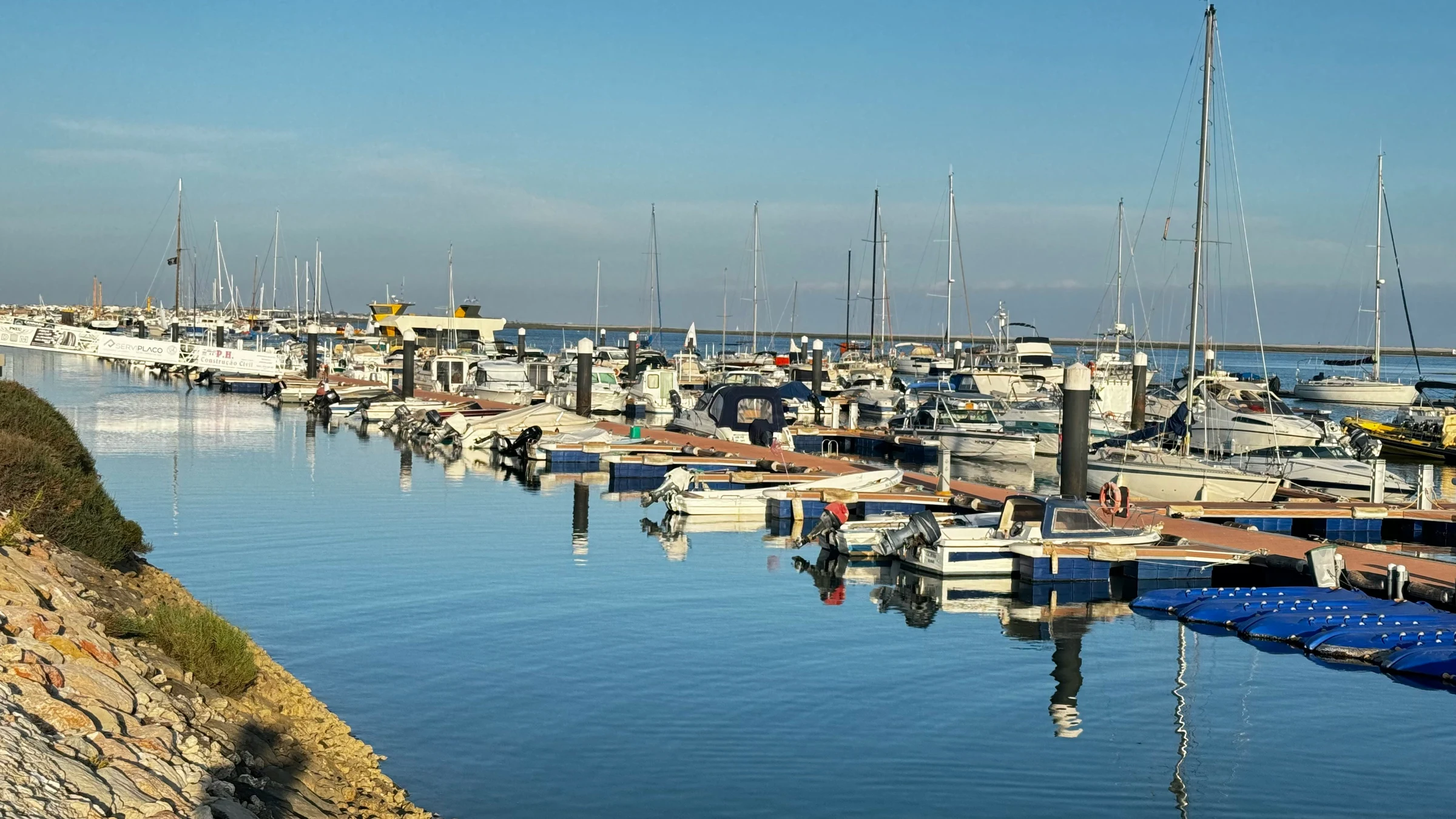
Olhão is a working fishing town on the eastern Algarve coast, about 15 minutes from Faro Airport. Its two waterfront market halls house the largest fish market in the region, and ferries from the harbour connect to the barrier island beaches of the Ria Formosa Natural Park.
Why Visit Olhão
Olhão is the Algarve town that tourism forgot to polish. About 15 minutes east of Faro Airport, it is the largest fishing port in the region, and that working identity defines everything about it: the two red-brick market halls on the waterfront, the harbour full of trawlers and nets, the restaurants that serve whatever came off the boats that morning. The town looks different from anywhere else on the coast. Its old quarter is a tight grid of whitewashed, flat-roofed houses with a distinctly North African geometry, a legacy of centuries of trade across the Strait. It gets called “the cubist city” for good reason.
None of this makes Olhão conventionally pretty. The centre has rough edges, some bland modern blocks, and streets that would never make the cover of a travel magazine. The waterfront, though, is a different story. The market halls anchor a promenade lined with restaurants and garden squares, and the ferry terminal connects to the barrier island beaches of the Ria Formosa. That combination, authentic fishing town plus gateway to some of the most beautiful and empty beaches in the Algarve, is what makes Olhão compelling. It is increasingly attracting artists and longer-term visitors who want something the resort towns cannot offer.
Best Things to Do in Olhão
The Waterfront Markets
The Mercados de Olhão are the reason most people come, and they deliver. Two massive red-brick buildings face the harbour: one dedicated entirely to fish, the other to fruit, vegetables, cheese, and local produce. The fish market is the largest in the Algarve, supplied daily by the fishing fleet that works the waters off the Ria Formosa. Sardines, sea bream, octopus, clams, razor clams, tuna, and whatever else the boats brought in. Saturday morning is when the whole thing peaks. A farmers’ market fills the area around the buildings with extra stalls selling bread, honey, smoked sausage, ceramics, and fig cakes. The atmosphere between about 8am and midday on a Saturday is the single best market experience in the Algarve.
The buildings themselves are worth noting. Often attributed to the Eiffel workshop (though this is disputed), they date from the early 20th century and their ironwork contrasts sharply with the whitewashed old town behind.
Ferries to the Ria Formosa Islands
Olhão is the main mainland gateway to the Ria Formosa barrier islands. Ferries and water taxis leave from the harbour to three islands: Armona (the closest, roughly 15 minutes), Culatra, and Farol. Each has long stretches of golden sand, warm water (the eastern Algarve is typically 1-2°C warmer than the south coast in summer, reaching around 22-24°C in August), and very little development. Armona and Culatra have small fishing settlements with restaurants and summer houses. Farol has a lighthouse and a tiny village of whitewashed houses linked by sandy paths. No cars on any of them.
The ferry schedules run regularly in summer and are reduced in winter. Budget at least a half-day if you are island-hopping, and bring water, sun protection, and cash (facilities on the islands are limited, especially on the quieter stretches of beach).
The Bairro dos Pescadores
The fishermen’s quarter behind the market is worth an hour of wandering. The streets are narrow, the houses cubic and whitewashed, the rooflines flat. It looks more like a Moroccan medina than a southern Portuguese town. The flat roof terraces were functional: they gave fishermen’s wives an unobstructed view of the harbour to watch for returning boats. Many houses still have the original proportions, though restoration work (some careful, some less so) is gradually changing the texture of the neighbourhood.
The fishing heritage murals on and around Rua da Fábrica Velha add context. Commissioned by the local council and painted from old photographs, they depict canning factory workers, fishermen mending nets, and scenes from the industrial era that shaped modern Olhão. The first canning factory in the Algarve was established on this street in the late 19th century.
Igreja Matriz de Nossa Senhora do Rosário
The main parish church on Praça da Restauração was built between 1681 and 1698 in Baroque style. The interior has gilt-carved woodwork, but the real draw is the bell tower. For a nominal fee, you can climb to the top for the best panoramic view of Olhão: the harbour below, rooftops fanning out behind it, and the Ria Formosa lagoon stretching to the horizon. Behind the church, the tiny Capela de Nossa Senhora dos Aflitos is where fishermen’s wives traditionally prayed for safe returns. Some still do.
Quinta de Marim
About 2.5km east of the harbour (walkable, cycleable, or a short drive), the Quinta de Marim is a 60-hectare nature reserve that serves as the Ria Formosa Natural Park headquarters. A 3km trail loops through pine forest, salt marshes, freshwater ponds, and tidal flats, with bird hides positioned along the route. The reserve contains a restored tidal mill, Roman-era remains, and a wildlife rescue centre (RIAS) that rehabilitates injured birds and other animals. Allow two to three hours. Small admission fee.
The Caíque Bom Sucesso
A replica of the fishing boat that made an improbable Atlantic crossing in 1808. After local fishermen rose against the French garrison during the Peninsular War, a crew sailed a small caíque to Brazil to tell the exiled King João VI that the invaders had been expelled. The king rewarded Olhão with a town charter, granting it independence from Faro. The replica sits in the harbour near the market and is free to visit. A small moment of history, but it explains why the town’s full name is Olhão da Restauração.
Festival do Marisco
The Algarve’s biggest seafood festival takes place in August, usually running for six evenings in the Jardim Pescador Olhanense on the waterfront. Dozens of food stalls serve fresh shellfish and regional dishes (cataplana, arroz de marisco, grilled prawns), and the festival programmes live music each night. It has been running for over 30 years and attracts tens of thousands of visitors. (Which means accommodation in Olhão during festival week books out well in advance.)
Best Beaches Near Olhão
Olhão has no mainland beach. Every beach trip involves a ferry crossing, which is both the inconvenience and the charm.
Ilha Deserta is the most remote option: an uninhabited barrier island with a single restaurant (Estaminé) and kilometres of empty sand. Ferries run from Faro, but some services depart from Olhão. Best for solitude and birdwatching.
Praia do Farol on Ilha da Culatra combines beach and village. The settlement of Farol is a cluster of whitewashed houses around a lighthouse, with a few restaurants and a long Atlantic-facing beach. The lagoon side (north) is calm and shallow, good for children.
Ilha da Armona is the closest island to Olhão (about 15 minutes by ferry) and has a small summer settlement with restaurants and beach bars. The ocean-facing side has long, open beaches. Not yet a standalone page on the site, but well worth the crossing.
For anyone not wanting to take a ferry, the town of Fuseta is one stop east on the train and has both a mainland beach on the lagoon and a ferry to its own island beach.
Where to Eat in Olhão
Olhão is one of the best places to eat in the Algarve, and the reason is simple: the fish market is right there. Restaurants source their ingredients from the morning catch, and the gap between the boat and the plate can be measured in hours rather than days.
The waterfront strip along Avenida 5 de Outubro is where most of the seafood restaurants cluster, tables spilling onto the pavement facing the harbour. The quality is generally high, though the experience is traditional rather than polished: grilled fish by weight, simple sides, honest wine lists. Chá Chá Chá, set on a cobbled street a few blocks back from the water, is the exception. Run by Kevin Gould, a former travel writer who fell for Olhão and stayed, it builds a daily-changing menu around whatever the market provides. More creative than the waterfront joints, but still grounded in local produce. Booking is essential in summer.
Vai e Volta is a different kind of experience. You sit down, and the kitchen sends out grilled fish until you tell them to stop. No menu, no choosing. It comes with tomato salad, boiled potatoes, and bread pudding. Cheap, generous, packed with locals. Closed Mondays.
Pitéu da Baixa Mar on the Avenida 5 de Outubro is a more conventional but reliable seafood restaurant with a strong local reputation, especially for its cataplana. Cestaria Bistro de Artesão, near the market, takes a slightly more modern approach, with well-executed octopus dishes and a solid wine list.
Beyond seafood: Pizza na Pedra on the waterfront does genuinely good pizza and is a reliable option for families or anyone who has eaten enough fish for one day. (It happens.)
Where to Stay in Olhão
Olhão’s accommodation leans toward boutique guesthouses, converted townhouses, and small hotels rather than large resorts. The old town has seen a wave of restoration over the past decade, turning traditional cubist houses into stylish short-term lets and B&Bs, many with the rooftop terraces that define the town’s architecture.
The Real Marina Hotel & Spa sits on the marina and is the largest conventional hotel in town, with a pool and spa. For something with more personality, the Convento is a boutique hotel in a converted building with a courtyard, plunge pool, and rooftop views. The growing number of guesthouses in the Bairro dos Pescadores puts you directly in the old town atmosphere. Prices drop significantly outside July and August, and the town is pleasant (and less crowded) well into October when daytime highs still reach 23-24°C.
Staying in Olhão rather than Faro gives you the waterfront restaurant scene on your doorstep and direct access to the island ferries without needing to drive. The trade-off is fewer shops and a quieter nightlife. For most visitors, that is the point.
How to Get to Olhão
Olhão is about 15 minutes east of Faro Airport by car, making it one of the easiest Algarve towns to reach. Take the N125 east; the motorway (A22) is an option but often adds time for such a short distance because of junction routing. From Lisbon, the drive is roughly 2.5 to 3 hours via the A2 south.
By train, Olhão is on the Algarve regional line. From Faro station, it is two stops east and takes about 10 minutes. The train station is centrally located in Olhão, a short walk north of the waterfront. The same line connects east to Fuseta, Tavira, and Vila Real de Santo António, and west through Faro to Albufeira and Lagos, making Olhão a practical base for day trips along the coast without a car.
Buses also connect Olhão to Faro and other Algarve towns, though the train is generally more convenient for the key destinations.
Parking in Olhão is manageable outside peak summer. Free street parking exists around the old town, and paid car parks serve the waterfront and marina area. In July and August, the streets closest to the market fill early, so aim for the car parks near the marina or the streets further back from the water.
Local Tips
The Saturday morning market is the single best experience in Olhão, but it rewards early starts. By 9am, the fish stalls are at their most dramatic and the outdoor farmers’ market is in full swing. By midday, the energy has shifted to lunch. If you time it right, you buy fish at the market, have coffee in one of the small cafés around the perimeter, and then walk directly to a waterfront restaurant for lunch.
Olhão is one of the few Algarve towns where you can genuinely get around without a car. The train connects to Faro, Tavira, and Fuseta (each worth a day trip), and the ferry terminal is steps from the market. If you do have a car, the Quinta de Marim is an easy drive east and makes a good morning before the market crowds build.
The town comes alive in the evenings along Avenida 5 de Outubro and the surrounding streets, when restaurants set up outdoor tables and the harbour light goes soft. In midsummer, air temperatures hover around 29-30°C during the day but the evenings cool to something more comfortable. The Festival do Marisco in August is the high point of the social calendar, but it also means the town is at its busiest, accommodation is at its most expensive, and restaurant queues are longest. If you want the atmosphere without the festival crush, the last two weeks of September offer warm weather, functioning ferry schedules, and considerably fewer people.
The fish market is busiest and most rewarding on Saturday mornings, when the indoor stalls are supplemented by an outdoor farmers' market. Get there before 9am for the best selection and the full atmosphere.