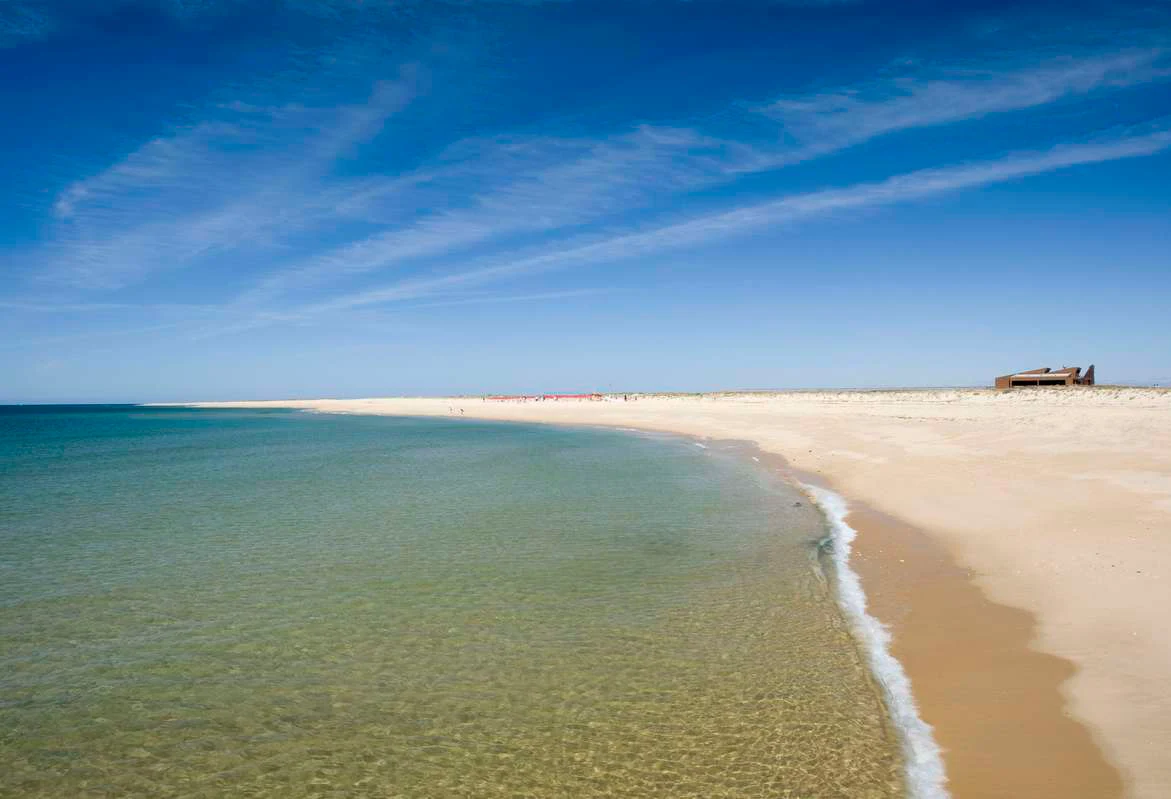
Ilha Deserta is an uninhabited barrier island in the Ria Formosa Natural Park, accessible only by ferry from Faro. Around 7km of near-empty beach, a single solar-powered restaurant, and the southernmost point of mainland Portugal at Cabo de Santa Maria.
Why This Beach
Ilha Deserta is exactly what its name promises. An uninhabited barrier island in the Ria Formosa Natural Park, roughly 7km long and at most 600 metres wide, with a single building on it: a solar-powered seafood restaurant. The Ria Formosa’s chain of barrier islands stretches from Faro to Tavira, each with its own personality. Ilha Deserta is the wildest of them: no roads, no cars, no houses, no resort infrastructure. The formal name is Ilha da Barreta, but nobody calls it that.
The island sits just off the coast of Faro, which is the strange part. Fifteen minutes from the airport, one of the Algarve’s emptiest beaches. The ferry crossing through the Ria Formosa’s tidal channels, past sandbanks and wading birds, is the transition between the Algarve most visitors know and something genuinely different. Cabo de Santa Maria, at the island’s southern tip, is the southernmost point of mainland Portugal. A 2km boardwalk threads through the dune system to reach it. On a quiet weekday in shoulder season, you might walk the entire length of the beach and see fewer people than you’d find at a single Albufeira café.
How to Get There
Ferries depart from Faro’s Porta Nova pier (Portas do Mar), near the old town marina. The operator is Animaris, who also run the island’s restaurant. The crossing takes between 30 and 45 minutes depending on the boat type (ferries are slower, speedboats faster), and the route winds through the Ria Formosa’s internal channels rather than heading into open sea. Services run year-round, with more frequent departures in summer and a reduced timetable in winter. Check current schedules directly with Animaris before going.
The pier is a short walk from Faro’s old town and about 10 minutes from the train and bus stations. If you are driving, paid parking is available around the marina and the Porta Nova area, but spaces fill up on summer mornings. The streets behind the marina tend to have more availability than the waterfront itself.
There is no way to reach Ilha Deserta other than by boat. You cannot drive, cycle, or walk there. Reaching the island from Olhão is technically possible (ferry to Ilha da Culatra, then a water taxi across), but it is indirect and uncommon. Faro is the practical starting point.
From Faro Airport, the Porta Nova pier is about 15 minutes by car or taxi. That proximity is part of the appeal: a genuinely remote beach within easy reach of a major transport hub.
What to Bring and What to Know
Bring everything.
The island has one restaurant and a small area with sun loungers for hire near the jetty. Beyond that: nothing. No shop, no kiosk, no vending machine, no shade. If you plan to spend the day on the beach rather than at the restaurant, pack water (more than you think), sun protection, a hat, and your own shade if possible. Cash is worth carrying for the sun lounger rental, though the restaurant accepts cards.
The beach runs the full ocean-facing length of the island. On the south side, the sand faces the open Atlantic. Water here is generally swimmable in summer, with sea temperatures reaching around 21-23°C in August (the eastern Algarve tends a degree or two warmer than the central coast). Conditions vary: the lagoon side is calm and shallow, suitable for wading and paddling, while the ocean side can have moderate waves and currents depending on the swell and wind. There is no lifeguard station.
Wind is a factor. The island is completely flat and exposed, with no cliffs, no dunes tall enough to matter, no buildings, no trees. On calm days, this is a non-issue. On windy days (and the Algarve gets more wind than the brochures suggest), the experience can shift from peaceful to unpleasant quickly. Check conditions before committing to the ferry.
The 2km boardwalk from the jetty area runs through the dune ecosystem toward Cabo de Santa Maria. It is flat and easy walking, with interpretive signs identifying coastal plant species along the way. Allow about 30 to 40 minutes each way. The Faro municipality has also designated a naturist area on the western section of the beach, near the boardwalk.
Birdwatching is the other reason people come here. The Ria Formosa supports over 300 recorded bird species. Flamingos, herons, terns, and black-winged stilts are common sightings from the lagoon side. Spring and autumn migrations bring the most variety. Even if birdwatching is not your thing, the crossing through the channels offers a sense of the ecosystem that is hard to get from the mainland.
One more thing: the Estaminé restaurant is better than it has any right to be for the only option on an uninhabited island. It runs entirely on solar power with its own water desalination system and serves fresh seafood from the Ria Formosa. The setting helps too: a wooden building with windows facing the beach, raised on stilts to sit lightly on the landscape. Book ahead in summer. It only serves lunch for general visitors, though group dinners can be arranged.
Nearby Beaches
Ilha Deserta is one of several barrier islands that form the seaward edge of the Ria Formosa, each with its own character. Together they make up one of the most distinctive coastal systems in Europe, and hopping between them is one of the better ways to spend a few days based in Faro or Olhão.
Praia do Farol is the western settlement on Ilha da Culatra, the next barrier island east across the channel. A small cluster of whitewashed houses, sandy paths, a lighthouse that gives the place its name, and several simple restaurants. The beach is long and the water equally clear, but the village gives it a lived-in warmth that Ilha Deserta deliberately lacks. A separate ferry from Olhão runs directly to Farol, and services from Faro also make the crossing.
Culatra, the fishing village on the eastern end of the same island, has its own ferry from both Faro and Olhão and a completely different feel. More working village than beach settlement, with a stronger local community and fewer day-trippers. The 3.6km walk between Farol and Culatra along the ocean-side beach is one of the quieter stretches of sand in the Ria Formosa. Worth doing in one direction and catching the ferry back from whichever end you finish at.
Praia da Ilha de Tavira is the easternmost of the main Ria Formosa island beaches, reached by ferry from the Tavira waterfront. It has more facilities than Ilha Deserta (beach bars, sun loungers, a boardwalk), and the water on the eastern stretch tends to be a touch warmer. A good option if you want the barrier island experience with slightly less commitment to self-sufficiency.
For something closer to Faro without the ferry commitment, Praia de Faro is on the peninsula accessible by car or bus from the city. It has the sand and the Ria Formosa backdrop, but also bars, restaurants, and parking. Useful if the weather turns or you miss the last boat.
Buy your return ferry ticket before you leave Faro. They do not sell tickets on the island, and boats fill up on busy summer days. If you buy a later return and want to come back earlier, you can ask the staff at the jetty if there are free seats on an earlier crossing.