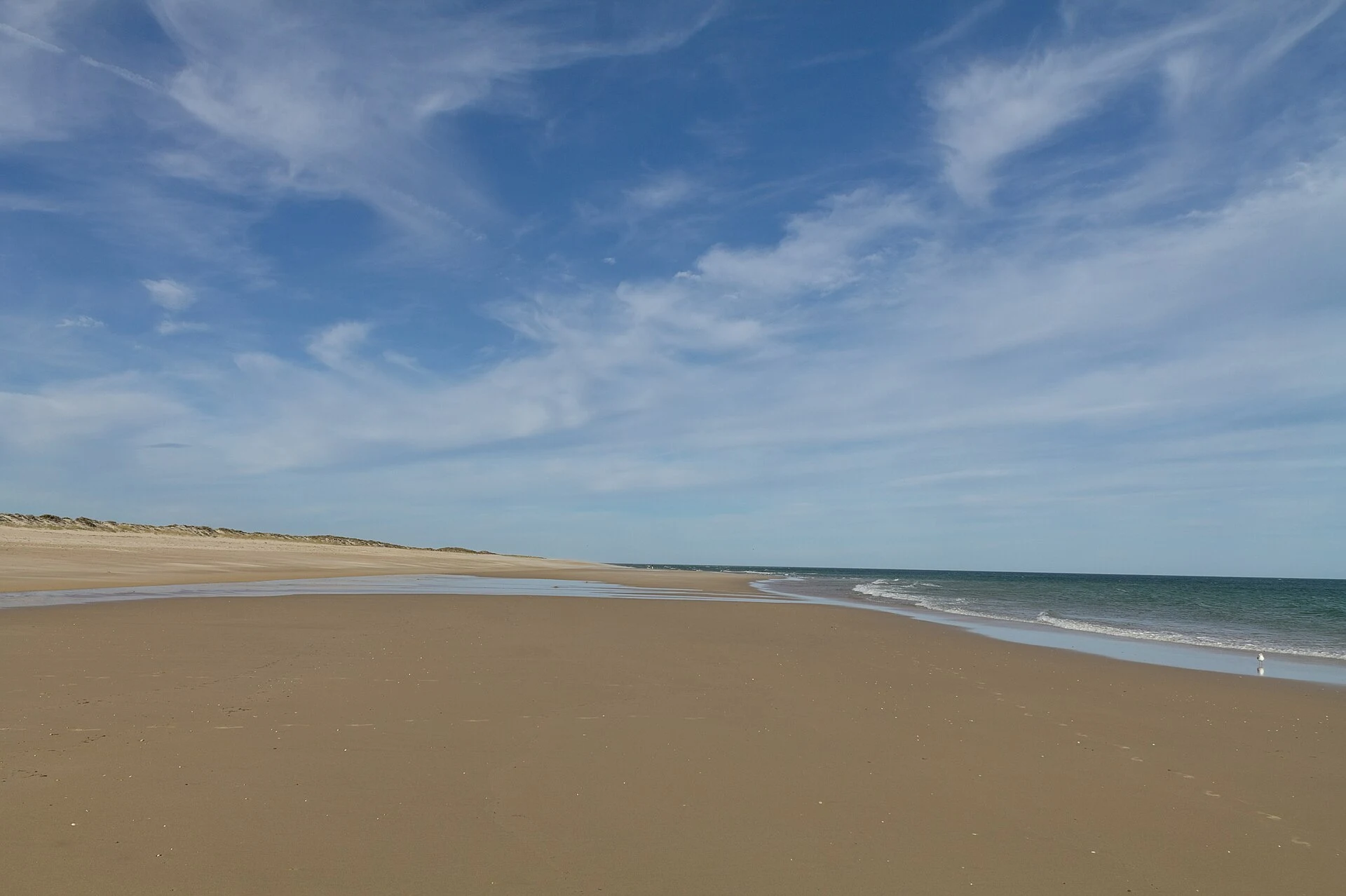
Praia da Culatra is a Blue Flag beach on Ilha da Culatra, a barrier island in the Ria Formosa Natural Park reached by ferry from Olhão or Faro. The beach stretches for kilometres behind low dunes, accessible via a 1km boardwalk from the fishing village of Culatra. Quieter and more remote than neighbouring Praia do Farol.
Why This Beach
Culatra is the quieter half of a story most visitors only hear one side of. The ferry from Olhão stops here before continuing to the more popular Farol at the western end of the island, and most people stay on the boat. Their loss. The beach on this side is the same continuous strip of white sand and clear water, but with fewer people on it. Considerably fewer.
From the Culatra pier, you walk through a fishing village where the main sounds are Portuguese conversation and the scrape of hulls being repaired. No cars (the only motorised vehicles are tractors dragging boats out of the water). Sandy paths between low, colourful houses. A church. A school. A handful of restaurants with fish that was swimming a few hours ago. Then a kilometre-long boardwalk through protected dunes, and the Atlantic opens up in front of you. The beach extends in both directions further than you’ll want to walk in one go. Turn east and within minutes the only company you’ll have is wading birds.
How to Get There
The primary ferry connection is from Olhão, departing from the terminal on the waterfront (Avenida 5 de Outubro). This is the most frequent service and runs year-round, though winter sailings are limited to a few per day. The crossing takes about 30 minutes. Ferries also run from Faro’s Portas do Mar pier, mainly during summer, taking around 40 minutes.
The Olhão ferry route serves both Culatra and Farol: the boat stops at Culatra first, then continues to Farol. On the return, the reverse. This makes the walk-between-villages strategy practical: arrive at one pier, walk 3.5km along the beach, leave from the other. Check the schedule before committing to this plan.
Note the last ferry time and take it seriously. Missing it means either a water taxi back (available but expensive compared to the regular fare) or a night on the island with no hotel. Ferries can get crowded on summer return trips, particularly late afternoon, so arriving at the pier with time to spare avoids the stress of watching a full boat pull away.
Parking is on the mainland. Olhão’s waterfront has parking near the ferry terminal, but spaces disappear fast on summer mornings. Faro’s Portas do Mar has paid parking. Neither Olhão nor Faro ferry terminals are far from their respective train stations, so arriving by rail from elsewhere in the Algarve is a genuine option.
What to Bring and What to Know
Bring everything. That’s only half a joke. The beach bar area near the boardwalk has sun lounger hire and drinks, and the village has restaurants, but once you walk ten minutes in either direction there is nothing except sand and dunes and empty sky. Water, sun protection, a hat, and food if you’re heading for the quieter stretches. Cash for the village restaurants and beach bar (card acceptance is patchy, and there is no ATM on the island).
Sea temperatures here follow the eastern Algarve pattern, running 1-2°C warmer than the south-central coast in summer. By August you’re looking at 22-24°C, genuinely comfortable swimming water. The beach faces south and the barrier island system provides some shelter, so conditions are usually calm. Visibility in the water is excellent for snorkelling, with seagrass beds and marine life in the surrounding Ria Formosa lagoon.
The walk from the pier to the beach takes 15-20 minutes, passing through the village then along the raised boardwalk across the dunes. The boardwalk protects fragile dune habitat, so stick to it rather than cutting your own path. (The dunes are a nesting area for several bird species within the Ria Formosa protected zone.) Once on the beach, the sand is fine and white, the gradient is gentle, and a lifeguard covers the main access area in summer.
The village of Culatra itself is worth more than a quick walk-through. The harbour, the lobster traps stacked along the paths, the fishermen mending nets: this is a working community, not a staged experience. Restaurants here serve fresh catch at lower prices than you’d pay in Olhão or Faro. Razor clam rice and caldeirada are local specialities. Don’t rush through on the way to the sand.
Nearby Beaches
Praia do Farol is 3.5km west along the same continuous beach, below the lighthouse and its cluster of colourful holiday homes. More facilities, more restaurants, a slightly livelier atmosphere. The walk between the two is one of the finest coastal walks in the eastern Algarve, flat and entirely on sand.
Ilha Deserta is the uninhabited island across the channel from Farol, reachable by ferry from Faro. No buildings except one restaurant, no shade, no other people if you walk for a bit. Together with Farol and Culatra, these three Ria Formosa islands make a compelling set: each has a distinct character, and combining two in a day trip is easily done.
Praia da Ilha de Tavira lies further east along the barrier island chain. Similar in feel to Culatra (ferry access, dune-backed, warm water) but reached from Tavira and with its own village and character.
Walk left (east) when you reach the sand from the boardwalk. Within ten minutes the beach is virtually empty, even in peak July. Bring your own shade: there is none beyond the beach bar area.