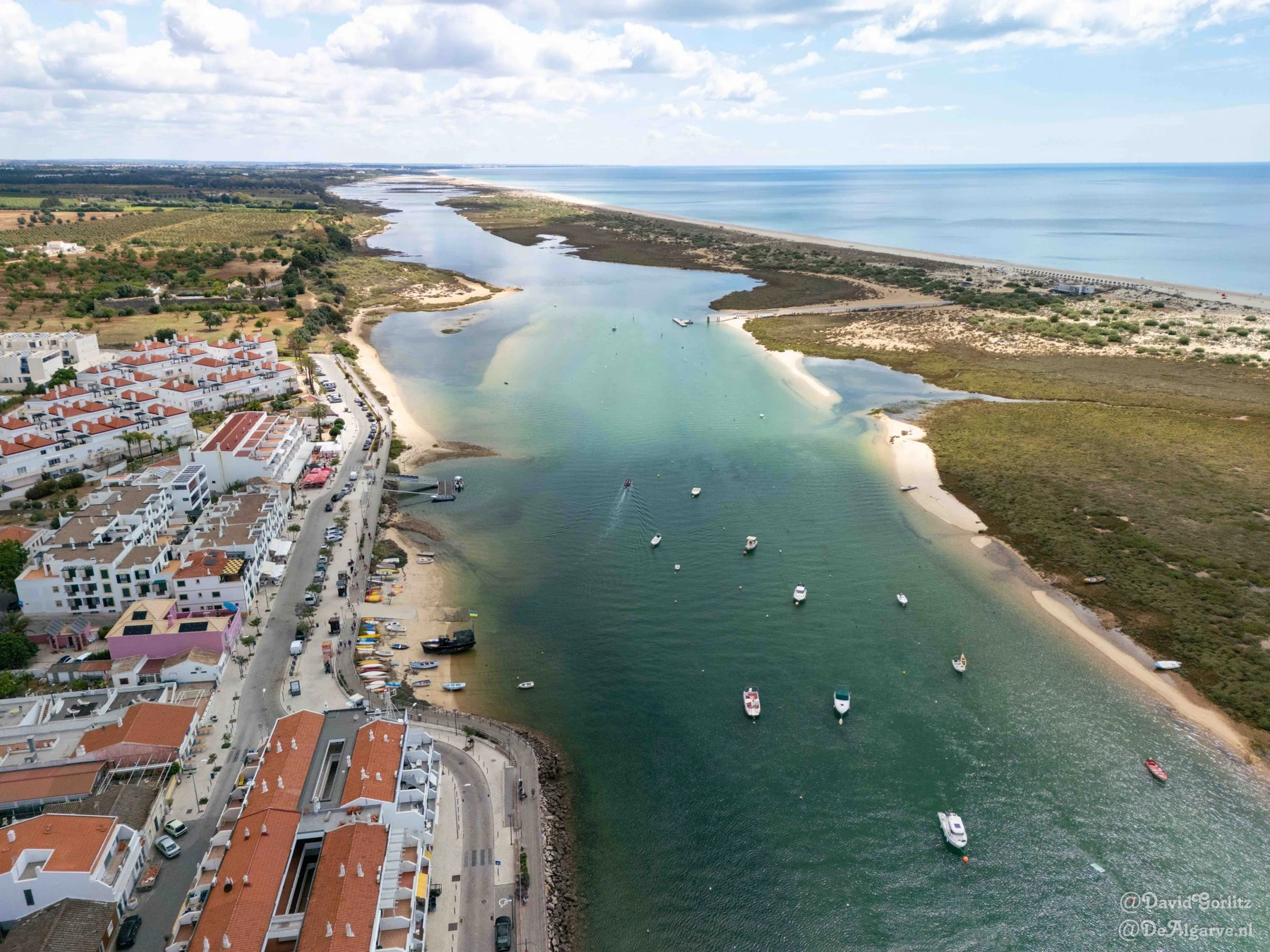
Cabanas de Tavira is a small fishing village 7km east of Tavira on the edge of the Ria Formosa Natural Park. A waterfront boardwalk, boat taxis to a long barrier island beach, and a surprisingly strong restaurant scene make it one of the eastern Algarve's most relaxed bases.
Why Visit Cabanas de Tavira
Cabanas de Tavira does one thing exceptionally well: nothing. That sounds dismissive, but in a region where even small towns compete for your attention with museums, fortress tours, and boat trip salespeople, Cabanas offers the rare experience of a place that simply lets you sit. The entire village is essentially a single waterfront avenue facing the Ria Formosa lagoon, with a wooden boardwalk, a row of restaurants, and boat taxis that shuttle you to a near-empty barrier island beach. The name comes from the fishing huts (cabanas) built here in 1734 when tuna fishing first brought seasonal workers to this stretch of coast. Some of those huts are still standing.
About 1,000 people live here year-round. The village lacks Tavira’s architectural beauty and Olhão’s waterfront market halls. It has no museum worth mentioning, no castle to climb. What it has instead is an unforced calm that the bigger eastern Algarve towns can’t quite replicate. The waterfront catches the evening light in a way that makes lingering over dinner feel like the point of the trip rather than something you do between activities.
Best Things to Do in Cabanas de Tavira
Walk the Ria Formosa Boardwalk
The boardwalk runs roughly 800 metres along the lagoon edge and is the spine of daily life in Cabanas. It’s flat, wheelchair accessible, and lined with benches. At low tide the lagoon drains to reveal fishing boats resting on the sand, and wading birds picking through the shallows. At high tide the water laps right up to the walkway. The walk itself takes fifteen minutes at a normal pace, but the point is not to walk it quickly.
Traditional fishermen’s huts from the village’s 18th-century origins still stand along parts of the route. They’re small, low wooden structures that look like they belong in a different century. (They do.)
Boat Taxi to Praia de Cabanas
The main reason most visitors come to Cabanas. Small boats depart from the pier on Avenida Ria Formosa throughout the day, roughly April to October, and the crossing to Ilha de Cabanas takes under five minutes. On the other side: a long, dune-backed beach that stretches about seven kilometres in both directions. Even in August it rarely feels crowded. Walk ten minutes in either direction from the landing point and you can have a stretch of sand to yourself.
The island has a seasonal beach bar with showers and toilets near the boardwalk landing, and sun loungers are available for hire in summer. Beyond that, facilities are minimal. Bring water and sun protection. The water on the eastern Algarve coast tends to be 1-2°C warmer than the south coast average, reaching around 22-24°C in August. Comfortable for swimming without needing the psychological preparation the west coast demands.
Visit the Salt Pans
Between Cabanas and Tavira, the landscape flattens into shallow salt pans where seawater evaporates to produce sea salt, as it has for centuries. Walking and cycling paths cross the area, and the birdwatching is excellent. Flamingos are regularly spotted feeding in the shallows from spring through autumn, and spoonbills, egrets, and stilts are present year-round. The salt pan walk is an easy cycle from the village and shows a side of the Ria Formosa that has nothing to do with beaches.
Forte de São João da Barra
A ten-minute walk east of the village brings you to this star-shaped fortress, built in 1656 to defend the entrance to Tavira’s harbour. It was expanded in the 1670s and served various military and administrative functions until being sold to a private owner in 1905. Classified as a Property of Public Interest, it was restored in 2007 and now operates as boutique accommodation with only ten rooms.
You can’t tour the interior unless you’re a guest, but the exterior and the views across the lagoon and barrier island are worth the walk. The building itself, compact and angular with bastions at each corner, is one of the best-preserved examples of its type in the Algarve.
Cycle the Ecovia do Litoral
The Ecovia do Litoral, a coastal cycling path that runs much of the Algarve’s length, passes through Cabanas. From the village you can ride west toward Tavira through the salt pans (about 7km, flat, scenic) or east toward Cacela Velha. The terrain is completely flat and the views are almost entirely lagoon and marshland. Bikes can be rented locally or at the Pedras da Rainha resort.
Best Beaches Near Cabanas de Tavira
Praia de Cabanas is the obvious choice and the reason most visitors are here. Accessed by boat taxi, it’s a long barrier island beach with warm water, soft sand, and enough space that you never feel hemmed in. Good for swimming, sunbathing, and doing very little else.
Praia da Ilha de Tavira is the next island beach to the west, accessible by ferry from the Tavira side. It has more facilities (restaurants, beach bars) and a livelier atmosphere than Praia de Cabanas, but correspondingly more people.
Praia de Cacela Velha sits to the east, reached from the hamlet of Cacela Velha by wading across a shallow lagoon at low tide. It’s one of the most photogenic beach approaches in the Algarve and among the quietest barrier island beaches in the region. Worth combining with a visit to Cacela Velha itself.
Praia do Barril, further west near Santa Luzia, is known for its anchor cemetery (a collection of old tuna fishing anchors arranged in the sand) and the miniature train that crosses the marshland to reach the beach. A good half-day trip from Cabanas.
Where to Eat in Cabanas de Tavira
For a village with roughly 1,000 residents, Cabanas has a restaurant scene that has no business being this good. The waterfront along Avenida Ria Formosa is lined with places to eat, and while some are unremarkable tourist operations, a handful are genuine draws.
Noélia e Jerónimo is the standout. Chef Noélia Jerónimo, self-taught and fiercely local in her sourcing, won Portugal’s Chef of the Year award and holds a Michelin recommendation. The menu changes daily based on whatever she picks up at the market that morning, with seafood dominating. The dining room is informal, the wine list is strong, and major Portuguese chefs regularly make the trip to eat here. Reservations are essential, particularly for dinner. Book several days ahead in summer. The restaurant sits on Rua da Fortaleza, a short walk from the main waterfront strip.
O Pedro occupies a prime boardwalk position with views directly across the lagoon. The fish stews and seafood risottos are consistently good, and the feijoada de lingueirão (razor clam bean stew) is a dish you won’t find on many menus outside the eastern Algarve. Solid across the board without the reservation pressure of Noélia.
Sabores da Ria has an upstairs terrace with lagoon views that justify the slightly higher prices. The mixed grilled fish platter is a good introduction to whatever’s coming off the boats, and the portions are generous. A reliable choice when Noélia is full.
For something more budget-friendly, O Monteiro delivers large portions of traditional Portuguese cooking at prices noticeably lower than the waterfront places. The cataplana de tamboril (monkfish stew in the traditional hinged copper pot) needs advance ordering but rewards the wait.
Where to Stay in Cabanas de Tavira
Cabanas has no large hotels. Accommodation is mostly self-catering apartments and holiday rentals, which suits the village’s character. The Pedras da Rainha resort complex, set in extensive pine-shaded grounds on the edge of the village, offers studios and apartments of varying sizes with pools, tennis courts, and a free boat service to the beach. It’s dated in parts but well located, and the grounds provide a different atmosphere from staying in the village itself. Families with children tend to base here.
For something more distinctive, the Forte de São João da Barra operates as a boutique guesthouse with ten rooms inside the restored 17th-century fortress. It’s peaceful, atmospheric, and a short walk from the village. Not cheap, but a rare chance to sleep inside a classified monument on the edge of the Ria Formosa.
The AP Cabanas Beach & Nature is a more recent addition, an adults-only hotel near the waterfront with rooms facing the lagoon. It fills a gap for visitors who want hotel-standard accommodation without the self-catering format.
Prices across the board are lower than equivalent accommodation in the central or western Algarve, and availability outside July and August is rarely a problem.
How to Get to Cabanas de Tavira
About 40 minutes from Faro Airport by car, taking the A22 motorway (tolled) and exiting at Tavira. The slightly longer N125 route (around 50 minutes) passes through Olhão and Tavira, which makes it a more interesting drive if you’re not in a rush. From Tavira, Cabanas is a ten-minute drive east.
The nearest train station is Conceição, roughly a 15-minute flat walk from the village centre. Trains from Faro run every couple of hours and the journey takes about 45 minutes. The walk from the station to the waterfront is straightforward but you wouldn’t want to do it dragging heavy luggage. Taxis don’t wait at Conceição station, so arrange pickup in advance or use a rideshare app.
A local bus connects Tavira bus station to Cabanas on weekdays, but the service is limited and does not run on Saturday afternoons or Sundays. For getting between Tavira and Cabanas casually, the bus works. For anything more ambitious, a car or rideshare is the practical choice.
From Lisbon, the drive is roughly three hours on the A2 and A22. Buses from Lisbon to Tavira take around four hours, with connections onward to Cabanas.
Local Tips
The village divides sharply between summer and winter. From roughly November through March, some waterfront restaurants close entirely, the boat taxis to the beach stop running, and Cabanas becomes genuinely quiet. If you’re visiting outside peak season, check restaurant opening times before planning a waterfront dinner.
The Avenida Ria Formosa waterfront faces roughly south and catches afternoon and evening sun. The best tables for a long sunset dinner are on the western end of the strip, where the views extend across the full width of the lagoon. Arrive before 7pm in summer if you want to sit outside without a reservation.
Cabanas functions well as a base for exploring the eastern Algarve beyond its own waterfront. Tavira is ten minutes away by car (or a pleasant cycle through the salt pans), Cacela Velha is a short drive east, and the Spanish border at Vila Real de Santo António is roughly 25 minutes. The village’s quiet evenings balance out the more active days you can build around it. Air temperatures in the eastern Algarve reach 29-30°C in July and August, which makes a calm evening on the boardwalk, with the lagoon breeze and a glass of something cold, feel less like a holiday cliché and more like a reasonable response to the heat.
The waterfront restaurants are busiest between 7pm and 9pm. Walk east past the last restaurant and you reach the Forte de São João da Barra in about ten minutes, with barely another person in sight. The sunset views from there, looking back across the lagoon, are better than anything you'll see from a restaurant table.