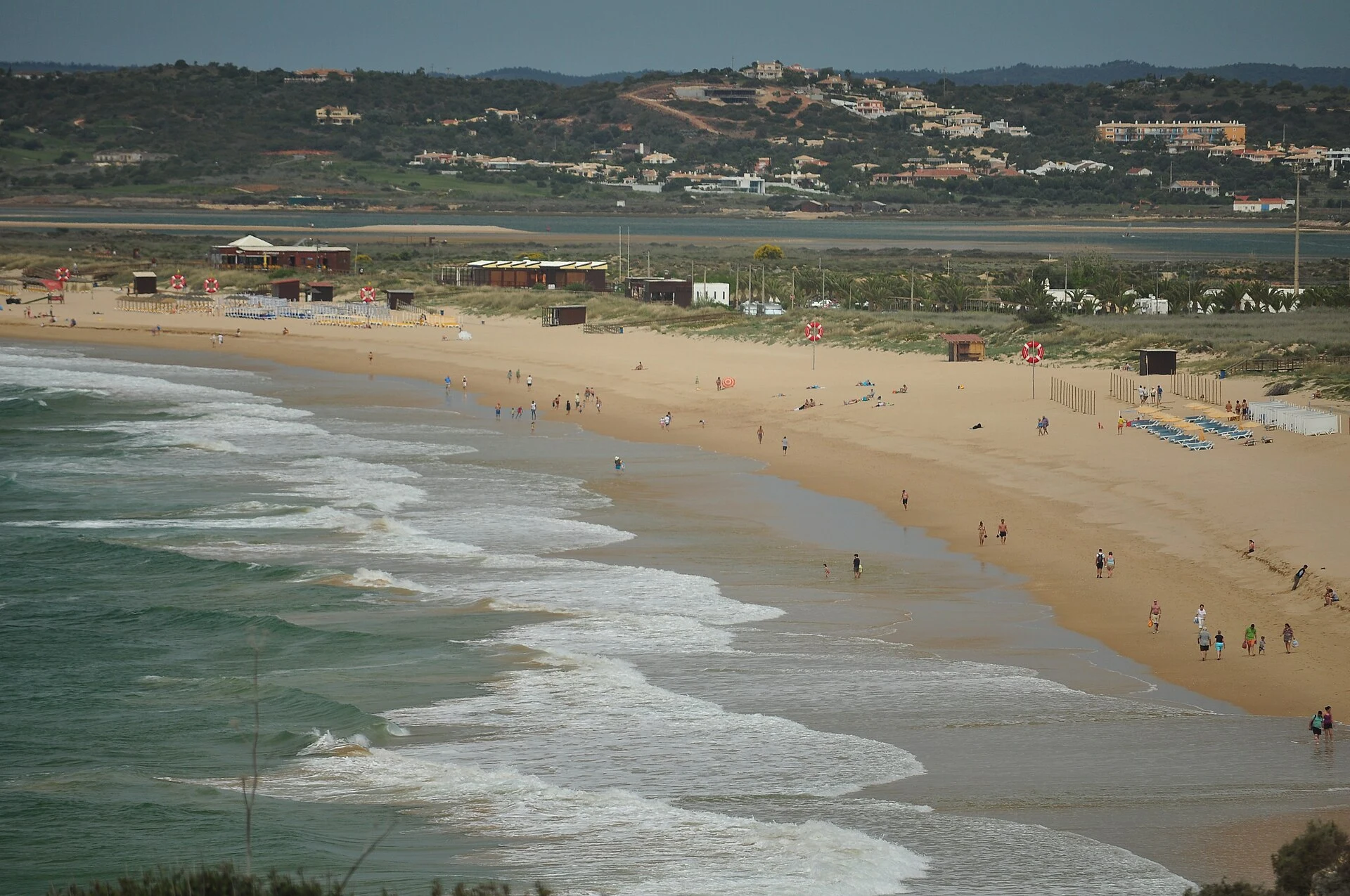
Praia de Alvor is a long, dune-backed beach stretching roughly 2km along the coast between the Alvor river estuary and the cliffs of Praia dos Três Irmãos. The wooden boardwalk through the Ria de Alvor Nature Reserve is part of the experience. A Blue Flag beach since 1987, it suits families and long walks, with kitesurfing on the estuary side and calmer swimming toward the centre.
Why This Beach
Most Algarve beaches are defined by their cliffs. Praia de Alvor is defined by what’s behind it: a protected estuary and dune systems, with a wooden boardwalk that winds through salt marshes before delivering you onto a wide, flat expanse of sand. The approach is half the point.
The beach itself stretches roughly 2km from the Alvor river estuary in the west to the rocky outcrops where Praia dos Três Irmãos begins in the east. No cliffs backing it, no dramatic rock formations on the sand. Just a long, open sweep of fine white sand that, at low tide, feels enormous. On a windy day, that openness works against you (sand in everything), but on a calm morning the scale of it is the reward. The Ria de Alvor lagoon sits behind the dunes, and the views north toward the Serra de Monchique give the whole scene a sense of depth that clifftop cove beaches simply don’t have.
It holds a Blue Flag and has done since the programme launched in Europe in 1987. The water is clean and clear, though Atlantic-cold until midsummer, when temperatures reach around 19-21°C.
The beach has two distinct personalities. The central section is serviced: sun loungers in rows, beach restaurants, parasols for rent. Walk west toward the estuary and things thin out rapidly. That end draws kitesurfers who use the Ria de Alvor lagoon, where shallow, warm water and steady afternoon Nortada winds (typically northwest, strongest June to August) create conditions that kite schools have built an entire industry around. Walk east and you’ll eventually hit the first rock formations of Três Irmãos, where the character shifts to cliffs and sea caves.
Worth noting: the beach is exposed. There’s almost no natural shade, and wind is a factor here more than at sheltered cove beaches. That’s the trade-off for all the space.
How to Get There
From Alvor village, walk south past the harbour and the line of wooden fishermen’s huts. Follow signs for the Passadiços de Alvor, the raised boardwalk that cuts through the nature reserve. The walk takes about 15 minutes at an easy pace and it doubles as a birdwatching route, with views over the estuary and salt marshes. During migration season, flamingos. The boardwalk is wide and flat, accessible for wheelchairs and pushchairs along its main section. Ramps lead down to the sand.
By car, follow signs from Alvor to “Praia de Alvor.” The main car park is behind the dunes, near the Complexo Desportivo de Alvor (sports complex). Search “Passadiços de Alvor” in Google Maps to find the right car park. Parking is free. A second, smaller lot sits closer to the beach restaurants and fills faster. In peak summer, the main car park can be busy by late morning, but it’s large enough that finding a space before 11am is rarely a problem.
From Portimão, the drive is about 10 minutes. Public buses connect Portimão to Alvor village throughout the day, though from the bus stop you still have the 15-minute walk to the sand.
There’s no direct public transport to the beach itself. A car or a willingness to walk from the village is the practical reality.
What to Bring and What to Know
Sun protection is non-negotiable. The beach is open and exposed, with no natural shade anywhere along its length. If you don’t rent a parasol (available in the central section), you’re relying entirely on what you carry.
Wind. This beach catches it. On a day with strong Nortada, the sand stings and umbrellas become a liability. Check the forecast before committing to a full day here. The cove beaches around Carvoeiro or Praia da Marinha offer more shelter on blowy days.
The water is generally clean and swimmable, but currents can be strong. The eastern end of the beach has some submerged rocks, so stick to the central and western sections for swimming with children. The estuary side (far west) has calmer, shallower, warmer water, though the river mouth itself has currents that deserve respect.
Cash is useful. The beach bars and restaurants generally accept cards, but the smaller vendors along the boardwalk may not. There’s no ATM at the beach, the nearest being back in Alvor village.
One thing the boardwalk doesn’t prepare you for: the scale. At low tide, the walk from the dunes to the waterline can be long. Bring water shoes if you’re planning to explore the rocky transition zone toward Três Irmãos at the eastern end. The sand is soft and flat on the main stretch, and walking barefoot is comfortable (this beach has some of the nicest sand texture on the central-western coast, if that’s the kind of thing you notice).
Nearby Beaches
Praia da Rocha is roughly 15 minutes east by car, across the Arade river via Portimão. A much more developed beach with towering sandstone cliffs and a long promenade lined with bars. More sheltered from wind than Praia de Alvor. Good if you want restaurants and bars within steps of your towel.
Praia dos Três Irmãos is technically walkable from the eastern end of Praia de Alvor, where the dunes give way to cliffs and rock formations. A completely different experience: dramatic ochre rocks and sea caves to explore at low tide. Popular with families because the rock pools create shallower areas for children. More photogenic than Praia de Alvor, more crowded too.
Prainha, just beyond Três Irmãos, is one of the most scenic small beaches in the area, tucked between high cliffs and accessible via steps or an elevator. If you’re already walking east along the coast, it’s worth the detour. The caves and rock arches here are some of the best on this stretch.
The further west you walk toward the estuary, the quieter it gets. The middle section near the beach restaurants is where the sun loungers cluster. Ten minutes on foot in either direction and you can have a wide stretch of sand to yourself, even in August.