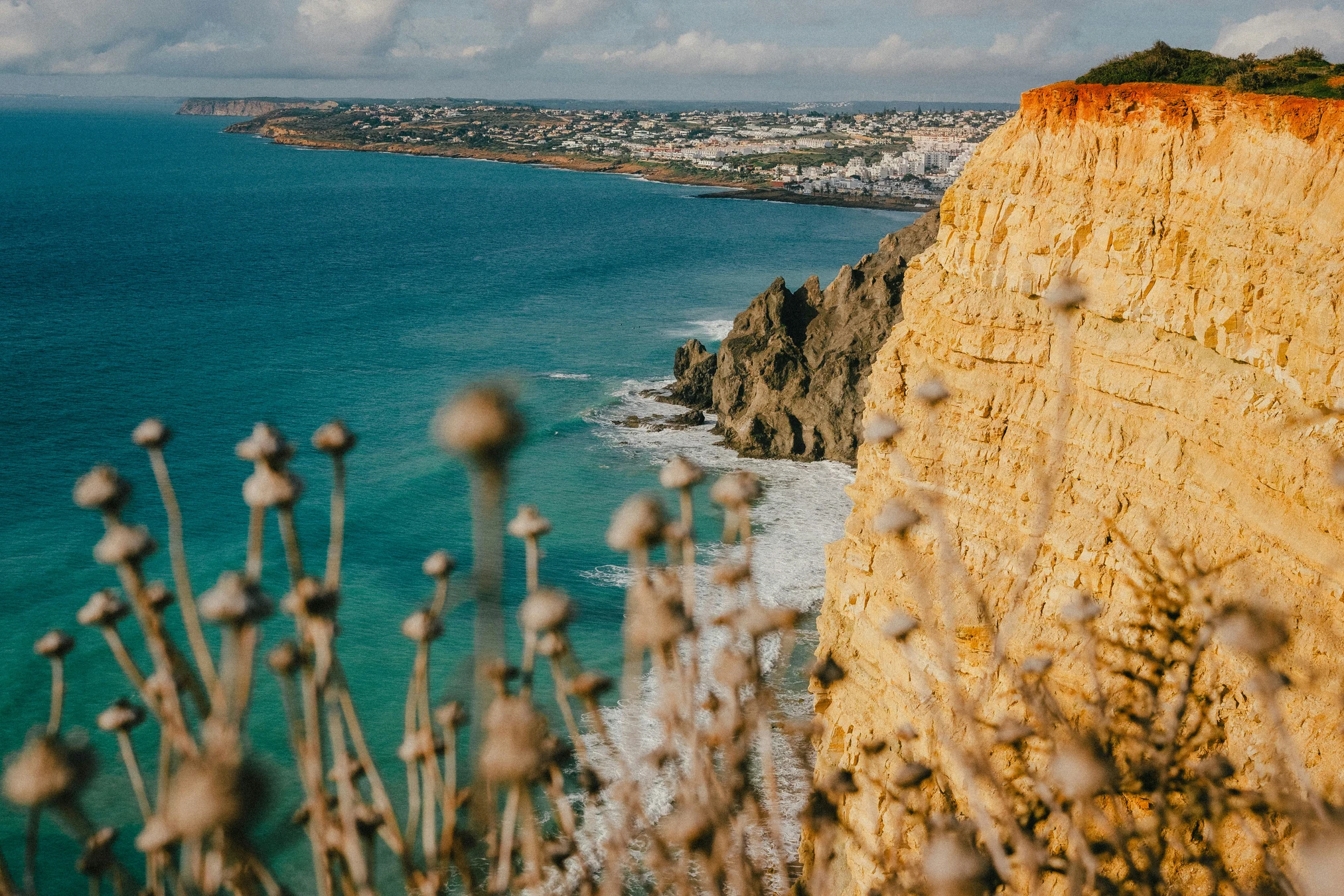
Luz is a small, quiet beach village on the western Algarve coast, about 6km west of Lagos. A sheltered south-facing bay, a dramatic volcanic rock formation, and a compact walkable centre make it one of the best spots in the region for families and anyone who wants the Algarve without the noise.
Why Visit Luz
Luz is the kind of place that doesn’t try to impress you. A compact village on a sheltered bay, backed by whitewashed houses climbing a gentle hillside, with a volcanic headland at one end and a 16th-century fortress turned restaurant at the other. It sits 6km west of Lagos, close enough to use as a base for the western Algarve but quiet enough that you’ll forget Lagos exists by the second evening.
The village grew from a fishing settlement into a low-key resort over the last fifty years or so, and it managed to do this without losing its shape. No high-rise hotels. No strip of loud bars. The promenade along the beach is lined with restaurants and cafés, and behind it a few streets of small shops and more restaurants form the entire centre. You can walk every corner of Luz in twenty minutes. That’s the point. The people who come here, a mix of families and British and German retirees who’ve been returning for years, come specifically because nothing about Luz demands their attention. It lets you be.
Skip this if you want nightlife, a bustling town centre, or variety in your evening entertainment. Luz has good restaurants but limited after-dark options. Lagos handles that job.
Best Things to Do in Luz
Hike the Rocha Negra
The most striking thing about Luz is the enormous dark volcanic rock at the western end of the beach. The Rocha Negra is basalt, roughly 150 million years old, formed from lava connected to the same volcanic activity that created the Serra de Monchique further inland. A trail with switchbacks climbs to the top. It’s steep in the first section but manageable in decent shoes. The views from the top cover the full sweep of the bay, the village below, and the Atlantic horizon. Late afternoon light is best for photographs, and sunset from up here is superb.
Wear proper walking shoes, not flip-flops. Bring water. The exposed rock gets hot in summer.
Walk the Clifftops to Lagos
The Fishermen’s Trail, the coastal section of the Rota Vicentina hiking network, ends (or begins, depending on your direction) at Luz. The section from Luz to Lagos is about 11km and takes roughly 3 hours, making it a perfect half-day activity. The route climbs from Luz up to the cliff plateau above the Rocha Negra, then follows the coastline east through increasingly spectacular scenery. You’ll pass Porto de Mós beach, hit the wooden boardwalks at Ponta da Piedade (some of the most photographed cliffs in Portugal), then descend past Praia do Camilo and Dona Ana before reaching Lagos old town.
Green and blue trail markers are painted every 40-50 metres. Navigation is straightforward. Getting back from Lagos is simple by Uber or the local bus.
The Roman Ruins
Most visitors walk past them without noticing. On Avenida dos Pescadores, the pedestrian promenade behind the beach, a small gate in the wall opens to a set of steps leading up to the excavated remains of a Roman bathhouse and fish-salting tanks. The site dates to the 2nd or 3rd century, possibly built over older Carthaginian foundations. The bathhouse has several rooms and fragments of mosaic flooring. The salting tanks (cetárias) sit to the east, separated from the baths by what was once a street. Free to visit.
Igreja de Nossa Senhora da Luz
The parish church, right in the centre near the Roman ruins and the beach, was first built in 1521. The 1755 earthquake destroyed most of the building, but the chancel survived, as it did again when a cyclone tore off the roof in 1941. That chancel is the reason to look inside: a late-Gothic star-ribbed vault with ornate keystones, an ogival triple arch supported by columns with Romanesque capitals, and a gilded Baroque altarpiece. The baptismal font is decorated with seven quinas, said to represent the seven sacraments. Architecturally, nothing else in the Algarve looks quite like it.
Rock Pools and the Western Shoreline
At low tide, the rock formations below the Rocha Negra create shallow pools. Sea urchins, small crabs, anemones. Bring water shoes. Children can spend an hour here easily, which is useful when you need a break from the main beach.
Best Beaches Near Luz
The town’s own beach, Praia da Luz, is the main draw: a wide arc of golden sand in a sheltered south-facing bay, with the Rocha Negra defining the western end and the Fortaleza anchoring the east. Calm water by western Algarve standards. Lifeguards in summer.
Head west along the coast and Praia de Porto de Mós is the nearest Lagos beach, reachable on foot along the clifftop trail in about an hour. It’s a wider, more exposed beach below high cliffs.
Meia Praia, on the other side of Lagos, is a long flat stretch of sand backing the harbour. Different character entirely: more space, more wind, better for long walks than sheltered swimming.
In the other direction, Burgau (about 5km west) has a small cove beach with a village atmosphere even quieter than Luz.
Where to Eat in Luz
Fortaleza da Luz is the headliner. The 16th-century fortress sits on the rocks at the eastern end of the beach, and the conversion into a restaurant preserved the walls and added gardens with Atlantic views. The seafood cataplana is the dish to order. Prices are higher than the village average, but the setting does the work. Sunday jazz brunches have a loyal following. Book the terrace.
For something less formal, Alloro is a small Italian restaurant a couple of streets inland that quietly outperforms most of the beachfront competition. The pasta is handmade, the risottos are dependable, and nobody is paying for a view. Good value.
Aquário is the local Portuguese pick. It’s family-run, tiny, and consistently packed for a reason. The fish is the thing. Presentation is careful, the portions are honest. It’s closed on Sundays, which catches some visitors out.
Chiccas runs a fixed-price tapas model: pick several plates per person from a rotating menu, and the portions are larger than they need to be. A practical choice when a group of four can’t agree on a single cuisine. The atmosphere is more energetic than most places in Luz, which isn’t saying a lot.
A useful pattern: the restaurants right on the promenade are convenient but tend to be more expensive for equivalent quality. Head a street or two inland and the food often improves while prices drop. Caféluz, slightly off the main strip, does good breakfasts and lunches.
Where to Stay in Luz
Most accommodation in Luz is privately rented apartments and villas in the residential developments that climb the hillsides behind the village. This is by far the most common option, and it suits the village’s character: you cook some meals, eat out for others, and walk down to the beach.
For a hotel, Hotel Belavista da Luz is a four-star option close to the beach with decent rooms and balconies. The Luz Bay Hotel and the Luzmar Villas are also established options. Boavista Golf Resort sits just outside town with apartments and villas, a pool, and an 18-hole course.
The trade-off is simple. Staying close to the beach means walkable access to everything but higher prices and more noise in summer. Staying uphill in the villa developments means a 10-15 minute walk to the sand but more space, often a pool, and better value. There’s no bad choice. Luz is too small for location to matter much.
Off-season visitors will find significantly lower prices and a quieter village. Some restaurants close or reduce hours between November and March, but the core options stay open and the weather is still mild enough for walking.
How to Get to Luz
From Faro airport, the drive takes about an hour via the A22 motorway. Exit at Lagos and follow signs westward. The road from Lagos to Luz takes another ten minutes through a stretch of countryside and roundabouts.
Luz has no train station. The nearest rail connection is Lagos, which is served by trains from Faro (about 2 hours, change at Tunes for some services) and from Lisbon (about 4 hours via the Algarve line, or faster intercity services via Albufeira and Tunes). From Lagos station, a local bus covers the 6km to Luz in about 15 minutes. Services run regularly in summer, less frequently off-season.
If you’re staying in Luz without a car, the bus connection to Lagos is your lifeline for wider exploration. Uber works in the area and a ride between Luz and Lagos typically costs around €10-15.
Parking in Luz has a paid lot close to the beach. In July and August, the central spots fill by mid-morning. Free parking exists in the streets further from the beach, but you’ll walk. Off-season, you can park almost anywhere without trouble.
Local Tips
The sunset from the viewpoint behind the Igreja de Nossa Senhora da Luz is better than the one from the beach, and almost nobody goes there. The church sits just above the promenade, and from the small garden behind it (once the cemetery) you get an unobstructed view west over the bay. Bring a drink from one of the nearby shops and you’ll have the best seat in town.
The tuna canning factory that once operated in Luz has been converted into Licks Gelato. A minor detail, but it says something about how the village evolved: fishing industry to ice cream, in the space of a few decades.
Luz is the last significant settlement before the coast turns wilder towards Sagres. If you’re interested in the western Algarve’s exposed Atlantic coastline and surf beaches, Luz makes a comfortable base with proper infrastructure. You’re 25 minutes from Sagres by car, and the contrast between the two places is dramatic. The same goes for the Serra de Monchique, about 30 minutes north: forests, cool air, and medronho (arbutus berry firewater) from a completely different Algarve.
The church viewpoint behind the beach gives one of the best sunset vantage points in town, and most visitors walk straight past it. Bring something cold to drink.