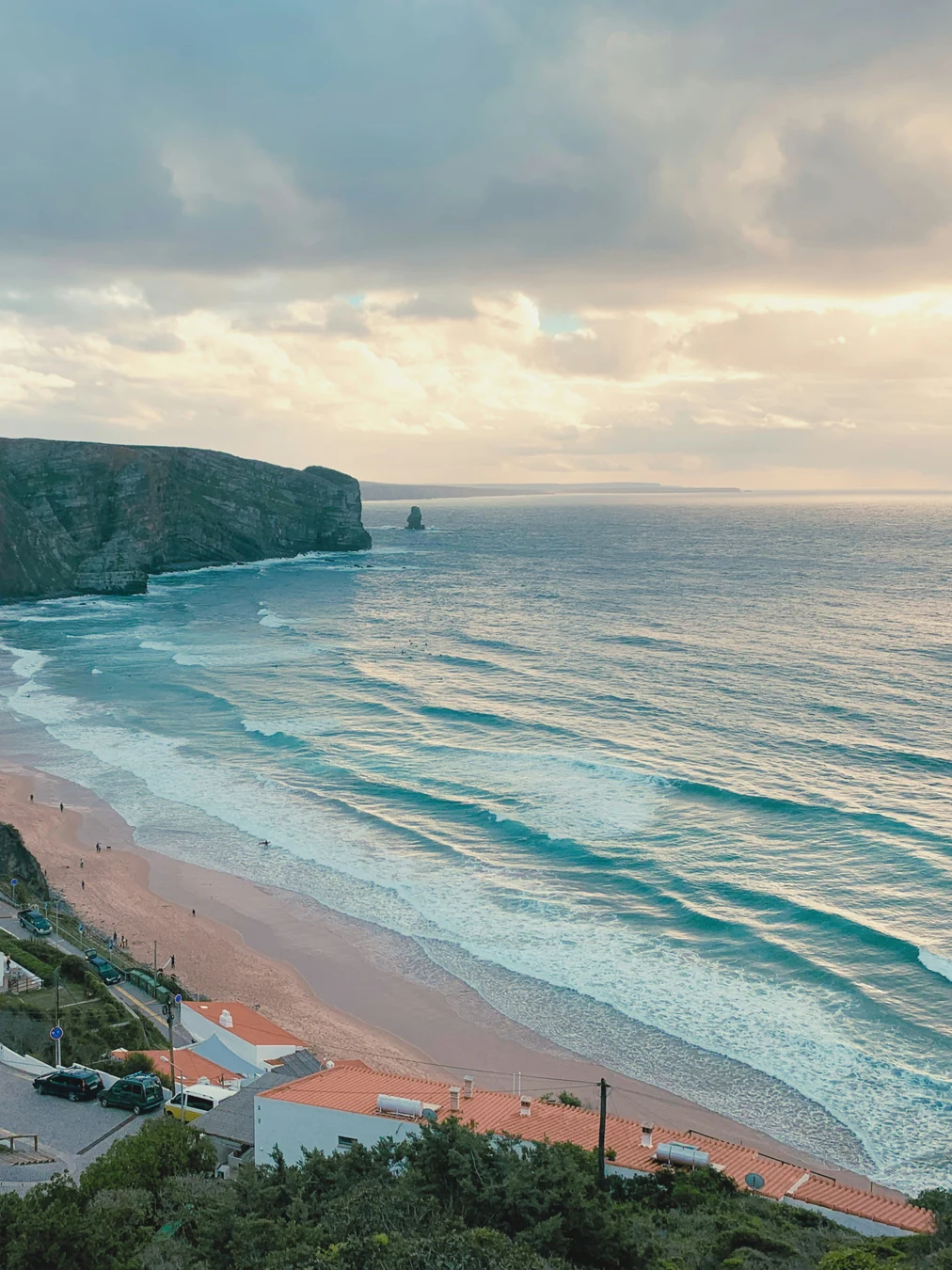
Aljezur is a small town on the Algarve's west coast, split between an old Moorish hilltop settlement and a newer lower town across the Ribeira de Aljezur. It sits inside the Costa Vicentina Natural Park and serves as the base for some of the region's best surf beaches, including Arrifana and Bordeira. The town is best for visitors who prefer raw coastline and quiet rural atmosphere over the resort-style southern Algarve.
Why Visit Aljezur
Aljezur feels like a different Algarve. Thirty kilometres north of Lagos, on the exposed west coast, the landscape shifts from manicured resort towns to something rougher: dark cliffs, Atlantic swell, and a natural park that covers the entire coastline. The town itself is small, about 6,000 people, and split into two halves by the Ribeira de Aljezur. The older half clings to a hillside below a 10th-century Moorish castle. The newer half sits across the river, built in the 18th century after a bishop ordered residents to move away from the malaria-ridden valley floor.
It is not a conventionally pretty town. The old quarter has faded charm rather than postcard perfection, and the new side is functional rather than scenic. But that honesty is part of the appeal. Aljezur has not been polished for tourism. The surf crowd, the yoga retreat visitors, the Northern European expats who have settled in the surrounding countryside: they came for the coast and the pace of life, not for the town centre. Which means the town centre has stayed more or less itself.
The real draw is everything around Aljezur. The Costa Vicentina Natural Park wraps around the entire municipality, and the beaches along this stretch of coast (Arrifana, Bordeira, Amado, Monte Clérigo, Amoreira) are among the most dramatic in Portugal. Add the Rota Vicentina hiking network and you have one of the best bases in the Algarve for anyone who prefers walking boots to sun loungers.
Best Things to Do in Aljezur
Walk the Moorish Castle Ruins
The castle sits on an 88-metre hilltop above the old town. It dates to the 10th century, when the Moors founded a settlement here to guard the river, which was navigable to the sea at that time. The Knights of Santiago captured it in the 1240s, and the 1755 earthquake did most of the damage you see today. Walls were partially reconstructed in the 1940s.
Entry is free. You can drive to a small car park at the top or walk up the steep cobbled lane from the old town, which takes about ten minutes and passes through the most atmospheric part of Aljezur. Information panels around the site cover the castle’s history from Bronze Age settlement to Christian conquest. The views are the real reward: the river valley and farmland below, the hills of Monchique to the east, and on a clear day, the Atlantic to the west. Worth 30-45 minutes.
Surf the West Coast Beaches
The municipality has over 40km of coastline and every beach catches Atlantic swell. Praia da Arrifana is the most popular, a dramatic half-moon bay below black cliffs with reliable waves and several surf schools. Praia do Amado, further south toward Carrapateira, is flatter and more forgiving, better for beginners. Praia da Bordeira is vast and exposed, with a river crossing and lagoon pools that create calmer areas alongside the open ocean.
Surf schools operate at Arrifana and Amado from spring through autumn, with group lessons available through local surf schools, equipment included. The water is colder than the south coast. A wetsuit is necessary year-round.
Hike the Rota Vicentina
The Fishermen’s Trail (Trilho dos Pescadores) runs along the clifftops from the Alentejo border down to Sagres, passing through Aljezur’s municipality. The Historical Way (Caminho Histórico) takes a parallel inland route through villages and farmland. Both are well-marked and can be walked in sections rather than end-to-end.
For a shorter option, the PR1 AJZ trail loops through the old town and surrounding countryside in about 4km. The Rota Vicentina website has detailed route maps and GPX files for all trails.
Visit the Town Museums
Aljezur has four small museums. They can be visited individually or with a combined ticket. Check at any of the museums for current options. The Museu Municipal in the old blue-and-white town hall has archaeological finds spanning the Neolithic to the 16th century, with a particularly good collection of Islamic-era ceramics. The Sacred Art Museum, attached to the 16th-century Igreja da Misericórdia, displays religious artefacts. The Museu Antoniano occupies a former chapel that became the parish church after the 1755 earthquake. None of them will take more than 30 minutes individually, but together they add up to a decent half-day of wandering the old town.
Attend the Sweet Potato Festival
Aljezur is Portugal’s most important sweet potato growing area, and the local Lira variety has EU Protected Geographical Indication status. The Festival da Batata-doce takes over the Espaço Multiusos in late November (the 2026 edition runs 28-30 November) for three days of cooking demonstrations, dessert competitions, over 100 exhibitors selling regional products, and live music. Entry and parking are free. Around 20,000 visitors attend across the weekend, making it the biggest event on the town’s calendar by a significant margin.
Even outside the festival, sweet potato turns up everywhere in Aljezur: baked as a side dish, fried as chips, folded into cakes and puddings. The soil and climate along this stretch of coast produce a sweeter, firmer tuber than you get elsewhere in Portugal. It sounds like a minor thing, but once you taste the difference you understand the festival.
Best Beaches Near Aljezur
Praia da Arrifana is the headline beach, 10km southwest of town. A sheltered bay framed by dark cliffs, good for surfing, with restaurants and cafés at beach level. The ruined Arab-era fort on the northern headland is worth the short walk for the views alone.
Praia da Bordeira is 20km south, one of the Algarve’s largest beaches. At low tide the sand stretches enormously. The Ribeira de Aljezur crosses the beach to the sea, forming calm, warm lagoon pools on one side that are good for children. Exposed to wind.
Praia de Monte Clérigo is the most family-friendly option, 10km west. A smaller bay next to a cluster of houses, with rock pools at low tide and calmer water than the more exposed beaches. Cafés and restaurants within walking distance.
Praia do Amado, further south toward Carrapateira, is the best beach for surf beginners. Flatter, more consistent, with several surf schools right on the sand.
Praia da Amoreira is where the Aljezur river meets the Atlantic, 9km northwest of town. The river creates a sheltered lagoon area alongside the open ocean. Good for families who want calm water and dramatic scenery without the wind exposure of Bordeira.
Where to Eat in Aljezur
Aljezur is not a dining destination. The restaurant scene is small and focused on traditional Portuguese food, with a few international options that have arrived with the surf and expat crowd. That said, the quality of ingredients here is excellent: fresh fish from the Costa Vicentina, sweet potatoes from the local farms, and medronho (strawberry tree fruit spirit) from the hills.
Pont’a Pé is the restaurant most visitors end up at, and for good reason. It occupies a century-old former inn on the riverbank in the old town, and the kitchen does straightforward Portuguese food well. The polvo com batata-doce (octopus with sweet potatoes) is the signature dish. The cataplana is solid. Skip the vegetarian options, which are limited. The lower dining room with the river terrace is better than sitting upstairs. Closed Sundays.
For something less formal, Arte Bianca does reliable wood-fired pizza on Rua 25 de Abril, the main street running through the newer part of town. Not remarkable, but affordable and quick.
The restaurant scene around the beaches is worth knowing about separately. Arrifana has a few clifftop restaurants above the beach, and these are often better for a long lunch than anything in town. The selection at Bordeira and Monte Clérigo is more limited.
One thing to be prepared for: restaurant choice in Aljezur is thin compared to Lagos or even Carvoeiro. If eating out is a priority for your trip, this is probably not the right base.
Where to Stay in Aljezur
Aljezur is not a resort town, and accommodation reflects that. There are no large hotels in the centre. Options divide roughly into three categories.
In and around the town itself, small guesthouses and B&Bs cater to hikers and those using Aljezur as a base. The Vicentina Hotel on the edge of town is the most conventional hotel option, with a pool and restaurant. Guesthouse A Lareira in the new town is a simpler, more affordable choice.
The Vale da Telha development, a few kilometres toward the coast, has a cluster of villas and apartments. It was originally built as a residential development and has a slightly suburban feel, but it puts you closer to the beaches and there are a few restaurants and a supermarket within walking distance.
For the surf-and-yoga crowd, the countryside around Aljezur is dotted with retreats and eco-accommodations ranging from glamping to converted farmhouses. These are popular in summer and tend to book up well in advance.
Budget travellers have a campsite option at the Parque de Campismo do Serrão, close to town.
The trade-off in Aljezur is always the same: you get quiet surroundings and proximity to empty beaches, but you sacrifice the restaurant choice and evening life you would get in a town like Lagos, which is only 35 minutes away.
How to Get to Aljezur
Aljezur is about 110km from Faro Airport, roughly 1 hour 10 minutes by car. Take the A22 motorway west toward Lagos, then head north on the N120 through the hills. The last section is a scenic two-lane road.
From Lagos, it is 30km north on the N120, about 35 minutes. From Lisbon, the drive is around 280km (roughly 3 hours) via the A2 south and then the N120 from the west coast.
Public transport exists but is impractical. There is no train station. Bus services run from Aljezur to Lagos and Portimão (operated by VAMUS), but frequency is limited, especially outside summer, and connections to Faro require at least one transfer with a total journey time exceeding three hours. There is no reliable bus service from Aljezur to the beaches.
A car is essential here. Not just recommended. The town, the beaches, and the trails are spread across a wide municipality, and public transport does not connect them in any useful way.
Parking in Aljezur town is free and generally easy. The beaches have car parks that fill up in peak summer, particularly Arrifana and Monte Clérigo. Arrive before 10am in July and August.
Local Tips
The town has two distinct halves, and most visitors only see one. The newer part around Igreja Nova and Rua 25 de Abril has the cafés, the supermarket, and the Saturday market near the bridge. The old town across the river has the castle, the museums, and the steeper, more characterful streets. Walk both.
Wind defines the west coast experience. It blows most afternoons, especially in summer, and it can turn a beach day uncomfortable on the more exposed stretches. The sheltered bays at Arrifana and Monte Clérigo handle this better than Bordeira or Amoreira. Check conditions before committing to a beach.
Aljezur sits close to the boundary between the Algarve and the Alentejo. The village of Odeceixe, 20km north within the same municipality, is technically the last Algarve settlement before the border. Its beach, where a river meets the sea in a dramatic valley, is one of the most photogenic in the region and worth the drive even if you are based further south. The bohemian streak in this part of the Algarve runs deeper than you might expect: yoga studios, organic farms, surf communities, alternative therapy centres. None of it is pushy or performative, which is probably why it works.
The Saturday market near the bridge is where local producers sell fresh fish, vegetables, honey, and sweet potatoes. Get there before 11am for the best selection. The rest of the week, Aljezur is noticeably quieter.